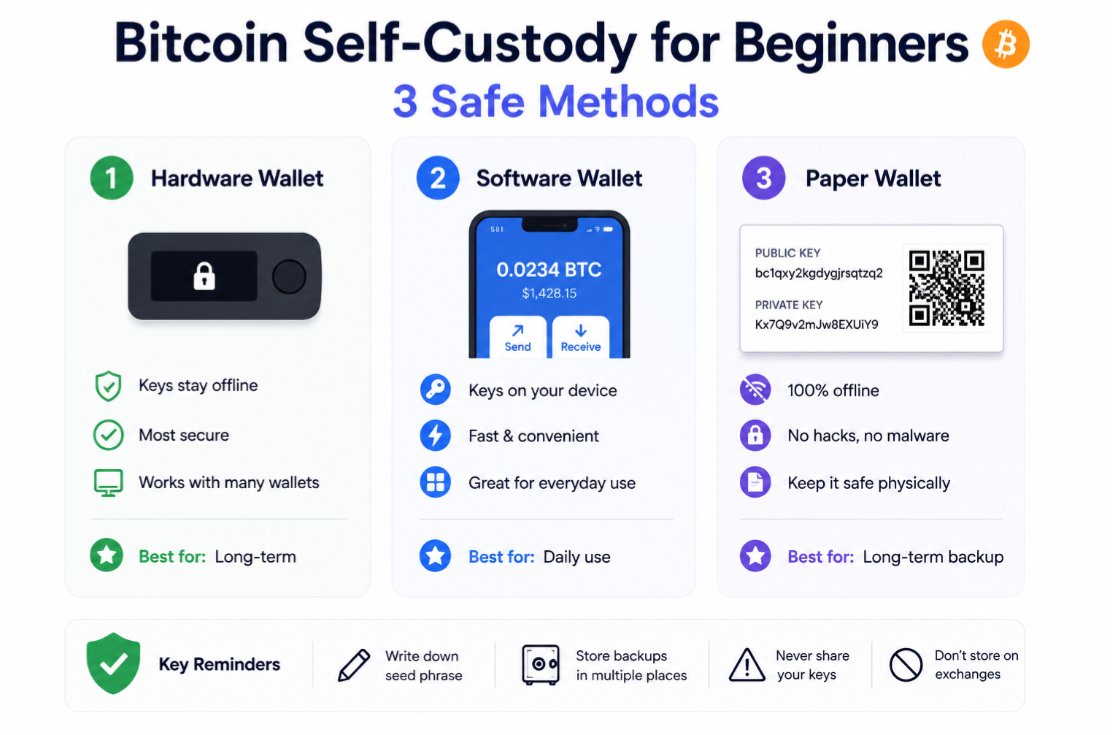
"Not your keys, not your coins" still rings true after a decade of exchange failures. Holding Bitcoin yourself is simpler than most beginners assume — provided you pick the right method for your balance and your habits.
Method 1: Mobile single-sig wallet (small balances)
BlueWallet, Muun, or Sparrow Mobile give you a self-custodial Bitcoin wallet that lives on your phone. The seed phrase is generated on-device and never leaves it. Suitable for spending money — think hot-wallet sums, under $1,000.
Method 2: Hardware wallet (medium balances)
A Ledger, Trezor, Coldcard, or SafePal device holds the private key in tamper-resistant hardware and signs transactions offline. Even if your computer is fully compromised, the attacker still cannot move your BTC without physical access to the device and the PIN. Suitable for $1,000 to mid-six-figure balances.
Method 3: Multisig vault (large balances)
A multisig wallet requires multiple keys (commonly 2-of-3) to authorize spending. Services like Casa and Unchained Capital provide guided setups where you, the company, and a recovery service each hold a key. Loss of any single key does not lock you out, and theft of any single key does not steal funds. Suitable for serious holdings.
Common beginner mistakes
- Buying a hardware wallet from Amazon or eBay — always order direct from the manufacturer.
- Storing the seed phrase as a photo in cloud-synced phone albums.
- Memorizing the seed instead of writing it down. People forget.
- Skipping the test transaction when sending real funds.
Building habits that actually keep BTC safe
- Buy your hardware wallet new and direct from the manufacturer.
- Generate the seed on the device. Write it down on paper, then transfer to a steel backup.
- Verify the receive address on the device screen — never trust the computer screen alone.
- Send a small test transaction before any large deposit.
- Practice a recovery once per year on a spare device.
Going deeper, see our hardware wallet comparison and our multisig wallet setup guide.