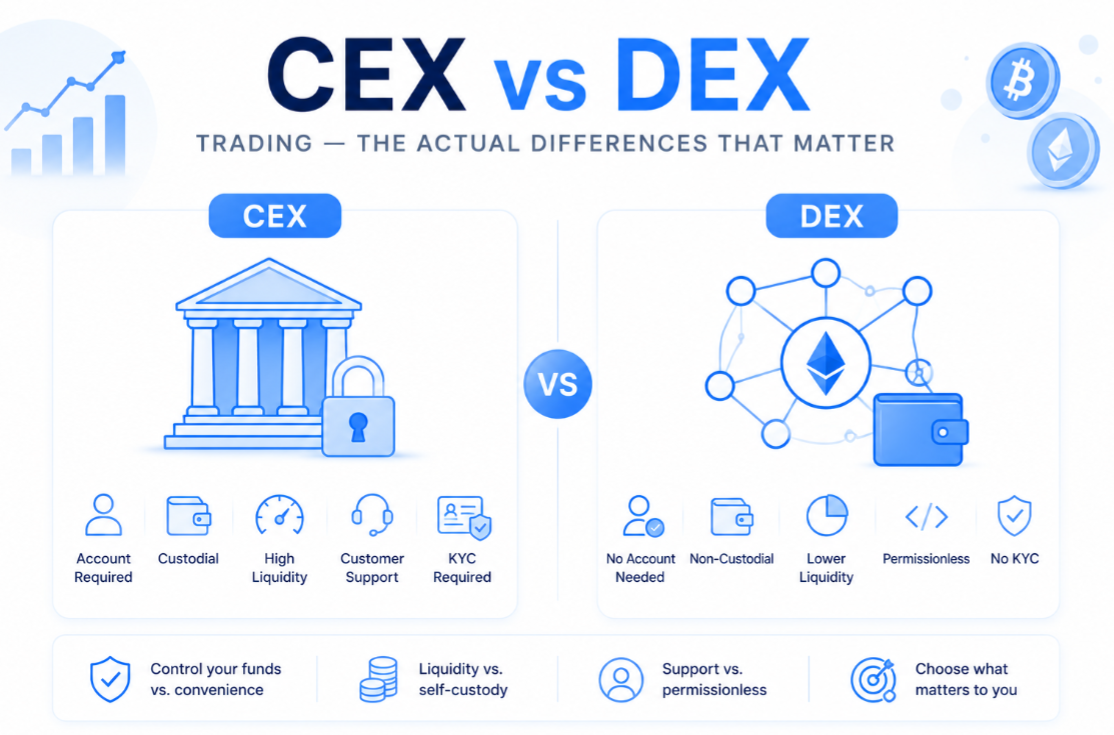
The choice between centralized exchanges (CEX like Binance, Coinbase, Kraken) and decentralized exchanges (DEX like Uniswap, GMX, dYdX, Hyperliquid) is presented in marketing as ideological — "not your keys, not your coins" vs "user experience matters." The actual choice is more nuanced. Different exchange types dominate different use cases for concrete operational reasons, and understanding those reasons lets you use the right tool for each trade instead of defaulting to whatever's ideologically preferred.
The custody difference
The core structural difference: CEXs hold your assets while DEXs don't.
**CEX**: you deposit crypto to an address the exchange controls. Your "balance" is a claim on the exchange's combined pool. You trade against other users on the exchange's internal ledger. To move funds elsewhere, you withdraw (an on-chain transaction).
**DEX**: your assets stay in your wallet. When you trade, you sign a transaction that moves assets between your wallet and the DEX contract. There's no "deposit and trade" — trading is a direct on-chain interaction.
Consequences:
- CEX failure (bankruptcy, hack, fraud) can lock or lose your funds. Historical examples: Mt. Gox, FTX, Celsius, various others.
- DEX failure (smart contract exploit) affects only what's in the specific contract at the moment; your other holdings are unaffected.
- CEX has full record of your trades and identity. DEX has on-chain record but pseudonymous.
For assets you're holding long-term or values you can't afford to lose: DEX or self-custody is safer. For active trading with meaningful volume: CEX is often more practical.
Execution quality
CEXs have historically dominated execution quality for major assets due to deeper order books and lower fees.
**CEX execution advantages**:
- Deep liquidity for major pairs (BTC/USDT, ETH/USDT can absorb millions without material slippage)
- Tight bid-ask spreads
- Fast execution (sub-second)
- Multiple order types (limit, stop-limit, trailing stop, iceberg, etc.)
- Reliable during volatile periods (though partial outages happen)
**DEX execution advantages**:
- Provably fair pricing (you can verify the exact execution logic)
- No withdrawal issues (assets are already in your wallet)
- Some DEXs match or exceed CEX depth for specific pairs (Hyperliquid for BTC-PERP, Uniswap for major DEX pairs)
For most retail-sized trades on major pairs, both work well. For very large trades or exotic assets, CEX usually has better depth.
Fees compared
Fees in 2026:
**CEX**:
- Coinbase: 0.4-0.6% for retail spot trades
- Kraken: 0.1-0.4% depending on volume
- Binance: 0.1% spot, ~0.02% for high-volume
- Withdrawal fees vary (often $5-25 for major assets)
**DEX**:
- Uniswap V3: 0.05-0.30% (depends on pool)
- Curve: 0.01-0.04% for stables
- Hyperliquid: 0.35 bps for takers, negative for makers
- Plus gas costs (few cents on L2, few dollars on Ethereum L1)
For small trades (<$1000), gas on Ethereum L1 can make DEX prohibitively expensive. On L2 or high-throughput chains, DEX often has lower total cost than CEX.
For large trades on major pairs, well-priced DEXs (Hyperliquid, Uniswap V3 on major pairs, Curve for stables) often beat CEX total cost including all-in.
KYC and regulation
**CEX**: full KYC required in most jurisdictions. Government-mandated reporting. Compliance with sanctions and legal requirements. Sometimes required to freeze accounts on government order.
**DEX**: no KYC. On-chain records are public but pseudonymous. Sanctions compliance handled at the frontend level (some DEXs block sanctioned addresses; the underlying protocol usually doesn't).
Consequences:
- Reporting: CEX reports to tax authorities. DEX trades are your responsibility to track and report.
- Access: some CEXs geo-restrict certain services (US Coinbase doesn't offer perpetuals, Binance restricts US users). DEXs generally don't restrict.
- Privacy: DEX offers more privacy for legal activities, but transactions are still traceable via chain analysis.
For most users, KYC compliance isn't a major concern. For users with specific privacy or access needs (regulated but restricted, cross-border), DEX may be the only option.
Speed and latency
CEXs execute in microseconds; DEXs execute in block times (12s on Ethereum L1, sub-second on Hyperliquid, ~250ms on Arbitrum).
For time-sensitive trading (front-running opportunities, tight arbitrage), CEX latency advantages are meaningful. For most retail trading, block-time execution is fine.
Some DEXs (Hyperliquid, dYdX) have narrowed the latency gap significantly. Others (Ethereum L1 DEXs) remain much slower.
Order types
**CEX**: full range of order types. Market, limit, stop, stop-limit, trailing stop, iceberg, TWAP, various conditional orders.
**DEX**: mostly market orders (for spot AMMs) or limit orders (for order-book DEXs). Advanced order types (stops, trailing) are typically implemented as smart-contract keeper services rather than native order types.
For traders who rely on stop-losses or complex conditional orders, CEX has significantly more capability.
Failure modes
**CEX failure modes**:
- Bankruptcy (FTX 2022, Celsius 2022)
- Hacks (Mt. Gox 2014, various)
- Frozen withdrawals during "restructuring" or "regulatory issues"
- KYC lockouts (account access denied)
- Government order to freeze assets
**DEX failure modes**:
- Smart contract exploit (funds in the specific contract at risk)
- Oracle manipulation (position value calculated wrong)
- Chain outage (temporary loss of access; funds preserved)
- Aggregator failure (bad routing)
- Wallet compromise (your problem, not the DEX's)
The failure modes are qualitatively different. CEX failures tend to be all-or-nothing (you're fine until you're not). DEX failures are more localized (specific contracts can fail while others are safe).
When to use CEX
Concrete situations:
- Very large trades that need deep liquidity
- Fast execution requirements (news trading, some MEV strategies)
- Complex order types (stops, conditionals)
- Fiat on-ramps and off-ramps
- Beginner-friendly UX
- Regulatory compliance where required
When to use DEX
Concrete situations:
- Self-custody as an ideological or practical priority
- Assets not listed on CEXs
- Long-tail altcoins with better liquidity on-chain
- Avoiding KYC when legal
- After a CEX has restricted your access
- Composability with other DeFi protocols (LP, lending, etc.)
For most users
Practical approach: use both.
**For long-term holdings**: self-custody (hardware wallet). Never leave meaningful long-term wealth on CEX.
**For active trading**: CEX for size and speed, DEX for chain-specific opportunities.
**For DeFi participation**: DEX (obviously — DeFi doesn't exist on CEX).
**For fiat access**: CEX (limited alternatives).
The ideological "always DEX" or "always CEX" positions are both wrong. Real users benefit from optionality.
The 2022 lesson
The FTX collapse in November 2022 taught the industry a hard lesson about CEX risk. FTX was one of the largest, most-trusted exchanges. Overnight it was gone, taking billions of user assets with it.
The takeaway isn't "never use CEX." It's "understand what you're trusting." Assets on a CEX are a claim on that CEX's solvency. Well-run CEXs (Coinbase, Kraken) have survived; others haven't.
Rules for using CEX safely:
- Diversify across multiple CEXs
- Never keep more than you actively need for trading
- Prefer well-established, transparent operators
- Use exchanges with proof-of-reserves reporting where possible
- Move gains to self-custody promptly
The direction of travel
CEX volume has held up despite DeFi growth. Perp DEXs have taken significant share from CEX perp trading (Hyperliquid especially). Spot DEXs have taken some spot share but less. CEXs continue to lead in fiat integration, complex order types, and beginner UX.
Long term, expect gradual DEX share growth for trading with continued CEX dominance in fiat services and enterprise-grade trading. Both will coexist for the foreseeable future.
Understanding the differences lets you use each for what it's best at. The tribal "CEX vs DEX" debate misses the point — they're different tools for different jobs, and serious users benefit from both.