Portfolio diversification is only diversification if the assets don't all move together. In crypto, most retail investors hold "diversified" portfolios of 5-10 different tokens that all correlate at 0.8+ during downturns. Understanding real correlations across crypto and between crypto and traditional markets is what separates real diversification from just spreading exposure across the same underlying risk factor.
What correlation actually measures
Correlation ranges from -1 to +1:
- **+1**: assets move perfectly together (BTC up 10%, other asset up 10%)
- **0**: assets move independently (no relationship)
- **-1**: assets move opposite (BTC up 10%, other asset down 10%)
Real markets rarely hit +1 or -1. Typical crypto correlations range from 0.3 to 0.9 depending on the pair and time period.
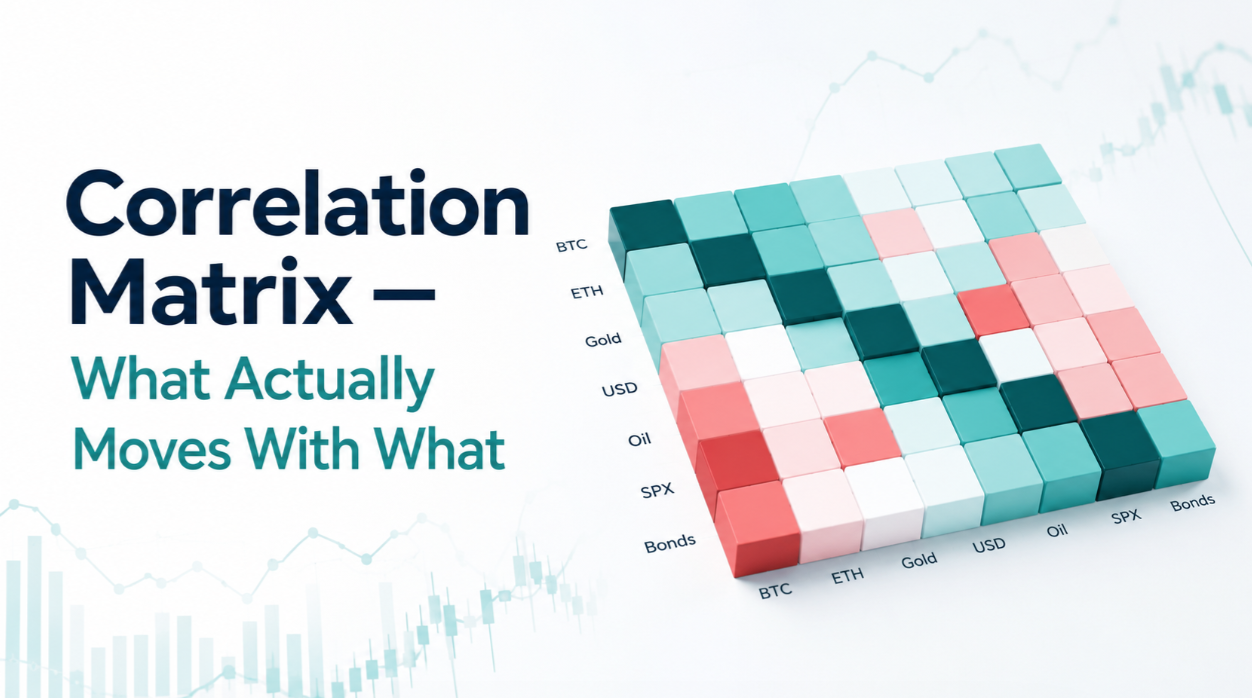
Correlation isn't stable — it changes over time and under different market conditions. Assets that are lightly correlated in normal markets often correlate more strongly during crises. This is the enemy of diversification: exactly when you need diversification most (crashes), correlations tend to rise.
Crypto internal correlations
Rough correlations of daily returns over multi-year periods:
**BTC vs ETH**: ~0.85. ETH moves with BTC most of the time, though with amplified volatility (higher beta).
**BTC vs SOL**: ~0.75. SOL has done its own thing at times (2020 accumulation, 2024 rally) but generally correlates.
**BTC vs top-10 L1s (AVAX, NEAR, etc.)**: ~0.7-0.85. All essentially crypto beta.
**BTC vs meme coins (DOGE, SHIB, PEPE)**: ~0.5-0.7. More independent, more speculation-driven.
**BTC vs privacy coins (XMR, ZEC)**: ~0.4-0.6. Less correlated to broader crypto due to specific use cases.
**BTC vs stablecoins**: ~0.0. By design.
The takeaway: holding 5 different large-cap alts doesn't diversify much. They're all essentially crypto beta with slightly different flavors. During a crash, they all crash together.
Ethereum ecosystem correlations
Within Ethereum-adjacent assets:
- ETH vs L2 tokens (ARB, OP, MATIC): ~0.7-0.85
- ETH vs DeFi tokens (UNI, AAVE, LDO): ~0.75-0.9
- ETH vs LSTs (stETH, rETH): ~0.98+ (essentially the same)
Ethereum ecosystem tokens correlate very strongly with ETH itself. Holding a diverse "Ethereum DeFi portfolio" is largely holding ETH with extra volatility.
Crypto vs equities
Historically:
- BTC vs S&P 500: 0.1-0.4 (loosely correlated)
- BTC vs Nasdaq: 0.2-0.5 (slightly stronger due to tech-heavy composition)
But: correlations have increased since 2020. Crypto has become more institutionalized and more sensitive to macro conditions. Modern correlations (2022-2026) with tech stocks are more like 0.4-0.6.
During specific events:
- Fed rate hikes 2022: BTC and tech stocks both crashed together (correlation spiked to 0.7+)
- SVB banking crisis 2023: BTC and stocks moved together initially, then diverged
- Various risk-off periods: correlations spike
The relationship isn't stable. Sometimes crypto acts as a risk-on asset (correlates with growth stocks), sometimes as a store-of-value (mildly correlates with gold), sometimes independently.
Crypto vs gold
BTC has been marketed as "digital gold." Correlation to actual gold has been variable:
- Multi-year average: ~0.2 (weakly correlated)
- During inflation fears (2021): temporarily correlated as both are seen as inflation hedges
- During banking crises: sometimes correlated, sometimes divergent
BTC is not consistently a gold substitute. It behaves like gold sometimes and like a tech stock other times, depending on the specific market narrative dominant at the moment.
Crypto vs bonds
BTC vs US Treasuries: ~-0.2 to +0.1. Weakly negatively correlated. Not enough to be a bond hedge.
When bonds fall (rates rising), crypto has often fallen too. When bonds rally (rates falling), crypto has sometimes rallied too. The relationship isn't clean or reliable.
The dollar factor
DXY (dollar index) vs BTC: ~-0.3 to -0.5. Modestly inversely correlated.
Strong dollar tends to be bad for BTC. Weak dollar tends to be good. This makes intuitive sense — BTC is often held as an alternative to dollar exposure, so dollar strength/weakness affects sentiment.
But the correlation is far from perfect. Other factors (crypto-specific news, macro conditions) can dominate.
Regime changes
Correlations change during different market "regimes":
**Bull market regime**: correlations often lower. Individual assets can rally on their own narratives.
**Bear market regime**: correlations rise. Everything sells together as risk-off dominates.
**Crisis regime**: correlations near 1.0. Nothing diversifies. Cash becomes king.
Recognizing regime changes is crucial for portfolio management. A portfolio that looked diversified in a bull market can turn into a concentrated bet in a crisis.
Real diversification requires uncorrelated assets
To reduce total portfolio risk, you need assets that genuinely move differently. Options:
**Within crypto**:
- BTC + stablecoins: real diversification (stables are ~0 correlated to BTC)
- BTC + short positions: negative correlation, but requires active management
- BTC + income-generating strategies (yield farming): partially uncorrelated (yields continue even during price drops)
**Outside crypto**:
- Traditional stocks and bonds
- Real estate
- Cash
For serious wealth (say, $500K+), having non-crypto exposure is essential diversification. Being 100% in crypto means one bad crypto cycle can dominate your net worth.
For smaller portfolios, the choice is different: if crypto is meant to be your growth allocation, being fully crypto might be intentional. Other asset classes might live in your retirement accounts or savings.
Correlation-aware portfolio construction
A concrete example. Two portfolios both allocated $10K:
**Portfolio A (fake diversification)**: $2K each in BTC, ETH, SOL, AVAX, NEAR. All correlate 0.75+. Effective exposure: 100% crypto beta.
**Portfolio B (real diversification)**: $4K BTC, $2K stables, $2K equity index ETF, $2K bonds. Correlations vary from -0.1 to 0.6. Actual diversification.
Portfolio A moves nearly identically to just holding BTC. Portfolio B has meaningfully different behavior with lower total volatility.
For portfolio construction, think in "risk factors" not just "assets." How many independent bets do you actually have?
What breaks correlations
Times when normal correlations don't hold:
**Chain-specific news**: an exploit on Solana breaks SOL vs BTC correlation temporarily.
**Regulatory action against specific assets**: SEC actions historically hit named tokens without affecting others.
**Major protocol failures**: Terra collapse affected UST and LUNA specifically while other stables held.
**Idiosyncratic events**: a specific project's major upgrade, hack, or fundamental change.
These are opportunities for excess return (or excess loss) but represent specific single-asset risk, not systematic exposure.
Tools for monitoring
Data sources for real correlations:
- **TradingView**: correlation studies on any asset pairs
- **CoinMetrics**: rigorous data science on crypto correlations
- **Kaiko**: institutional-grade data on crypto/equity correlations
- **Portfolio tracking apps**: some (Kubera, DeBank, Delta) show correlation matrices for your specific holdings
For most retail investors, checking correlations quarterly is sufficient. Extreme changes (correlations spiking during crises) are worth immediate attention.
The behavioral trap
Investors love the illusion of diversification. Holding "10 different projects" feels safer than holding 3. But if those 10 all correlate at 0.85, the diversification is largely fake.
Real diversification requires uncomfortable choices — holding stablecoins during bull runs (feels boring), holding equities during crypto pumps (feels like missing out), keeping cash during "unmissable" opportunities.
The reward is meaningful reduction in total portfolio volatility and better long-term returns due to less catastrophic drawdown risk.
The takeaway
Correlations determine whether your "diversified" portfolio actually diversifies or just multiplies bets on the same risk factor.
For crypto-native investors, real diversification is hard because most crypto correlates. Adding non-crypto assets or truly-independent crypto strategies (short positions, yield strategies) is where diversification lives.
Ignoring correlations means occasionally getting hit by drawdowns you thought you'd diversified away from. Respecting them means constructing portfolios that actually behave the way their nominal composition suggests.
The math is straightforward. The behavioral discipline to actually implement uncorrelated allocations is where most portfolios fail.