Crypto derivatives volume routinely tops $200B/day in 2026, more than 4× spot volume. Perpetuals (perps) are the dominant instrument. Understanding the mechanics — funding, liquidation, margin — separates traders who survive from those who do not.
What a perp actually is
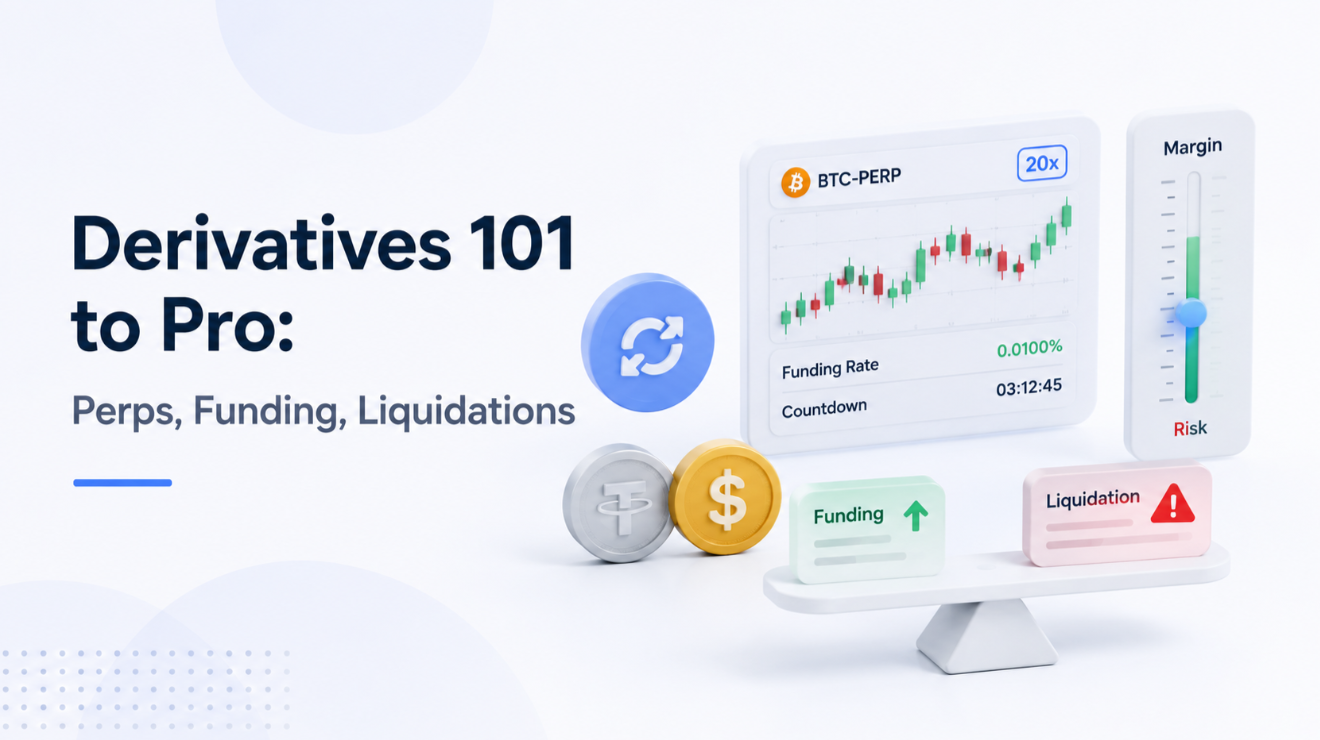
A perpetual futures contract tracks the spot price of an asset without an expiry date. The price is anchored to spot through a funding rate — long positions pay short positions (or vice versa) periodically. When longs dominate, funding is positive (longs pay shorts). When shorts dominate, funding flips negative.
Funding mechanics
Funding is paid every 1, 4, or 8 hours depending on the exchange. Typical 2026 funding rates for BTC are 0.01%/8h — about 11% annualised — but can spike to 0.1%/8h during euphoric phases. Sustained positive funding signals crowded longs; extreme positive funding often precedes a flush.
Margin types
- Isolated — Each position has its own margin. Liquidation affects only that position.
- Cross — All positions share collateral. Lower liquidation risk per position; one bad trade can drain the account.
- Portfolio margin — Available on Binance, OKX for qualifying accounts. Net exposure across positions determines margin.
Liquidation math
Liquidation happens when your margin falls below the maintenance margin requirement. Most platforms partial-liquidate first, then fully liquidate. A 10× long on BTC liquidates if BTC drops roughly 9–10% from entry; a 50× long liquidates on a 2% move. High leverage is almost always a portfolio-destroyer for retail traders.
Where the leading perps live in 2026
- Binance Futures — Largest by volume; strong liquidity; full menu of pairs.
- Bybit — Strong second; user-friendly UI; competitive funding.
- Hyperliquid — Largest DEX perp; on-chain order book; gas-free trading; HYPE token.
- dYdX v4 — On-chain perp DEX on its own Cosmos chain; institutional-friendly.
- Drift — Solana-native; cross-collateral with LSTs.
How professionals manage risk
- Risk 1–2% of account per trade — never more.
- Use limit orders, not market orders, except for emergencies.
- Always set a stop-loss before entering — written, not in your head.
- Watch funding rates as a sentiment indicator; extreme readings signal exhaustion.
- Avoid leverage above 5× for directional trades; use leverage only for hedging beyond that.
See our crypto trading strategies and our how to read crypto charts.