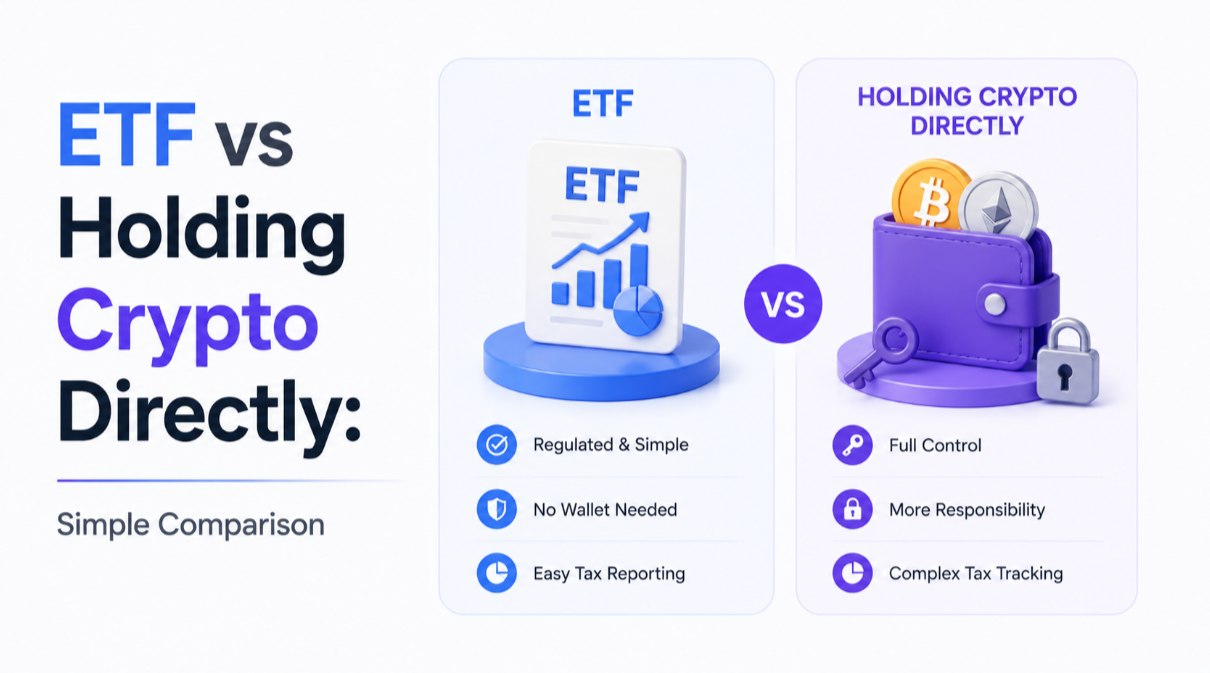
Crypto ETFs have been mainstream since 2024. For most retail investors, the choice between an ETF (IBIT, FBTC, ETHA) and holding real crypto is now genuine — both are easy. The answer depends on what you actually want from the position.
When the ETF is the right choice
- You hold most of your investments in IRAs, 401(k)s, or traditional brokerage accounts.
- You want estate-planning simplicity.
- You do not want to manage wallets, seed phrases, and self-custody.
- You value the option to trade options or margin against your position.
When holding actual crypto is the right choice
- You want to use the crypto for spending, payments, or DeFi yield.
- You expect to hold long-term and want to avoid expense ratios.
- You want 24/7 settlement and movability.
- You prefer self-sovereignty over institutional custody.
Cost comparison
A spot Bitcoin ETF charges 0.20–0.40% per year. On a $100k position over 10 years, that is $2,500–$5,000 in fees. Self-custody costs a hardware wallet ($80–150) plus the time to learn. For long horizons, self-custody is significantly cheaper.
Tax considerations
- ETF — Standard brokerage 1099 reporting. Same long-term / short-term distinction as stocks.
- Self-custody — Track every transaction yourself or via tax software. More work but more flexibility (specific ID, tax-loss harvesting).
The hybrid approach most pros use
Hold ETFs in tax-advantaged accounts where you cannot easily own real crypto. Hold real crypto in taxable accounts where you can self-custody and use it actively. This combines the benefits of both without choosing one exclusively.
See our spot Bitcoin ETF vs self-custody deep-dive for more detail.