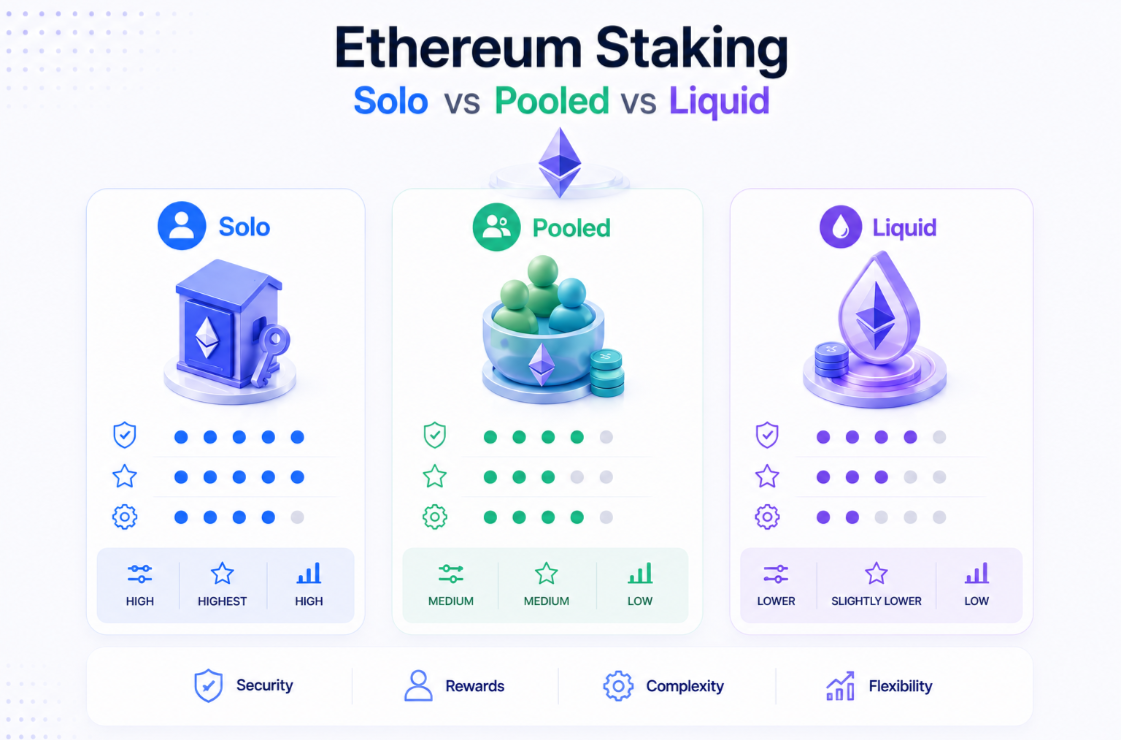
After Pectra and the Dencun follow-ups, Ethereum staking is mature: 30M+ ETH staked, 800k+ validators, dozens of liquid staking tokens. The three paths — solo, pooled, liquid — have crystallised into distinct trade-offs.
Solo staking: 32 ETH, full yield, full responsibility
Run your own validator on consumer hardware (NUC, Pi 5, or even a beefier laptop). Net APR after the Merge sat around 3.4%; in 2026 it averages 3.0–3.7% plus 0.4–0.9% MEV. You earn the full reward minus pool fees (because there are none). Slashing risk is yours — typically 0.0–1.0 ETH for misbehavior, up to your full stake for malicious double-signing.
Pooled staking: any amount, capped slashing exposure
Through Rocket Pool, Stakewise, or a CEX, you join a pool of operators. Yields are slightly lower (5–15% protocol fee). Slashing is socialised across the pool, so single-validator failures barely affect you. No 32 ETH minimum — Rocket Pool rETH starts at any amount.
Liquid staking: capital efficiency wins
Deposit ETH, receive stETH (Lido), rETH (Rocket Pool), eETH (ether.fi), or swETH (Swell). The token represents your stake + rewards and remains usable across DeFi (collateral, LPs, restaking). Around 35% of all staked ETH is now liquid.
Side-by-side comparison
- Net APR — Solo 3.0–3.7% + MEV; Pooled ~3.0%; Liquid 2.8–3.3% (after ~10% protocol fee).
- Minimum — Solo 32 ETH; Pooled ~0.01 ETH (rETH); Liquid 0 ETH (any amount).
- Slashing risk — Solo: full stake; Pooled: shared; Liquid: socialised across thousands of operators.
- Liquidity — Solo: 2–14 days exit queue; Pooled: similar; Liquid: instant via DEX swap, with minor peg risk.
- Tax treatment — Solo and pooled: rewards taxed at receipt. Liquid (rebasing): taxed at receipt; LST (non-rebasing): taxed at unwrap or sale.
- DeFi composability — Solo: zero; Pooled: limited; Liquid: full (Aave, Curve, Pendle, EigenLayer).
When solo staking still makes sense
You have 32 ETH or more, you value full sovereignty, you want maximum yield, and you accept the operational burden (a node that needs to be online). For amounts above 100 ETH, distributed validator tech (Obol, SSV) shares the operational load while preserving solo-staker yields.
When liquid staking wins
You want to lend, borrow, LP, or restake the same ETH. You want immediate exits via DEX. You hold less than 32 ETH. You accept the additional smart-contract and peg risk in exchange for capital efficiency.
For LST-specific risks, see our liquid staking tokens guide. For restaking on top, our EigenLayer deep-dive.