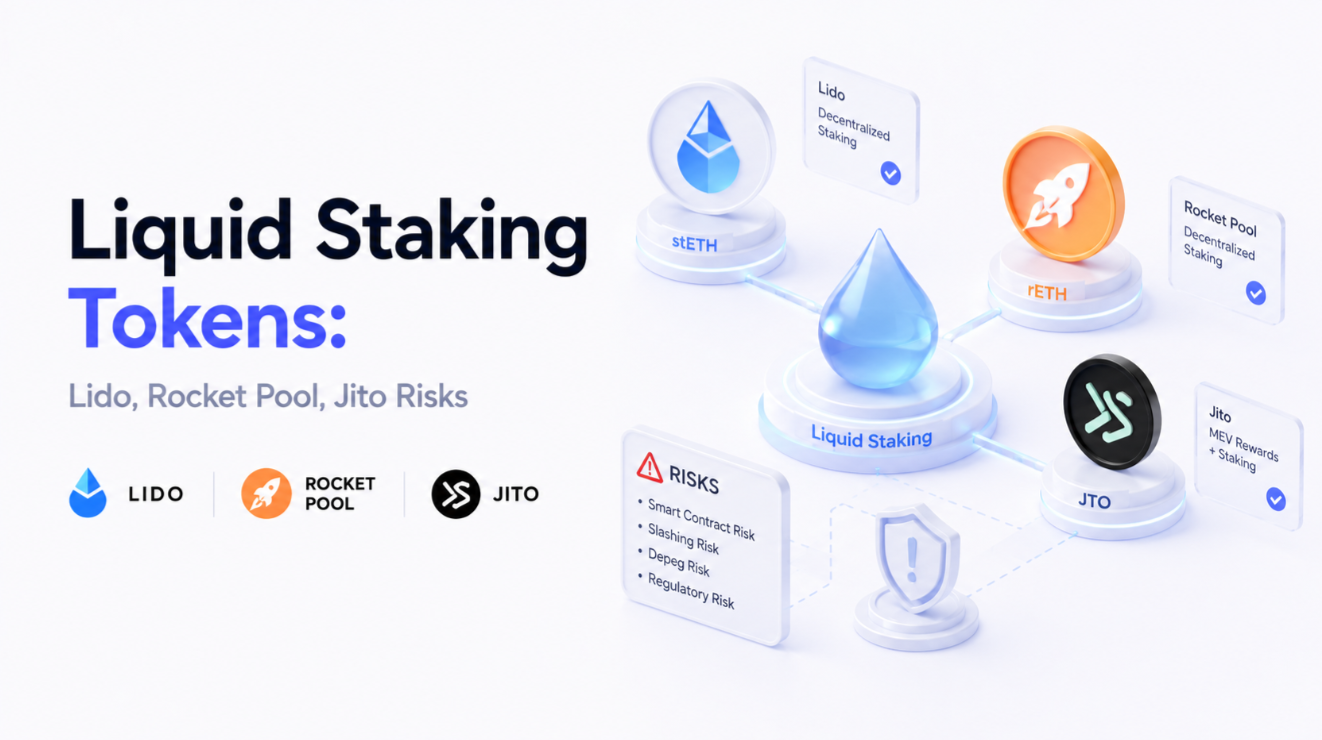
Liquid staking is now the dominant way to stake on both Ethereum and Solana. The leading LSTs are battle-tested, deeply integrated with DeFi, and carry real but generally well-understood risks.
Ethereum LSTs
- stETH (Lido) — Largest LST, ~22% of all staked ETH. Mature, deeply integrated, criticised for size concentration.
- rETH (Rocket Pool) — Decentralised node operator network. Smaller than Lido, stronger community alignment.
- eETH (ether.fi) — Native restaking-friendly LST. Each depositor has assigned validators; designed for the EigenLayer era.
- swETH (Swell) — Network-native LST; less DeFi penetration than the above but growing.
Solana LSTs
- jitoSOL (Jito) — Largest Solana LST. Earns base staking + MEV revenue from Jito's validator client.
- mSOL (Marinade) — Older, decentralised validator selection.
- bSOL (BlazeStake) — Smaller but well-integrated with Kamino, Drift.
Risks that actually matter
- Smart contract risk — Each LST is a separate codebase. Lido has been audited dozens of times; smaller LSTs less so.
- Peg risk — LSTs trade on AMMs and can briefly deviate (stETH dipped to 0.93 ETH in May 2022, recovered within days).
- Concentration risk — A dominant LST captures a large share of network security; outages or governance failures have outsized effects.
- Slashing socialisation — When a Lido or Jito operator is slashed, the loss is spread across all stakers — typically very small per holder.
- Validator censorship — Concentrated LST operators have come under pressure to censor (e.g., OFAC-compliant blocks); see ongoing 2023–2026 debates.
How to size LST exposure
Most users hold one LST. Active DeFi users sometimes split across two for diversification. Above 10–20% of total holdings, single-LST concentration is meaningful enough to justify diversifying. Below that, the operational overhead of multiple LSTs usually outweighs the benefit.
See our Ethereum staking guide and liquid restaking tokens compared.