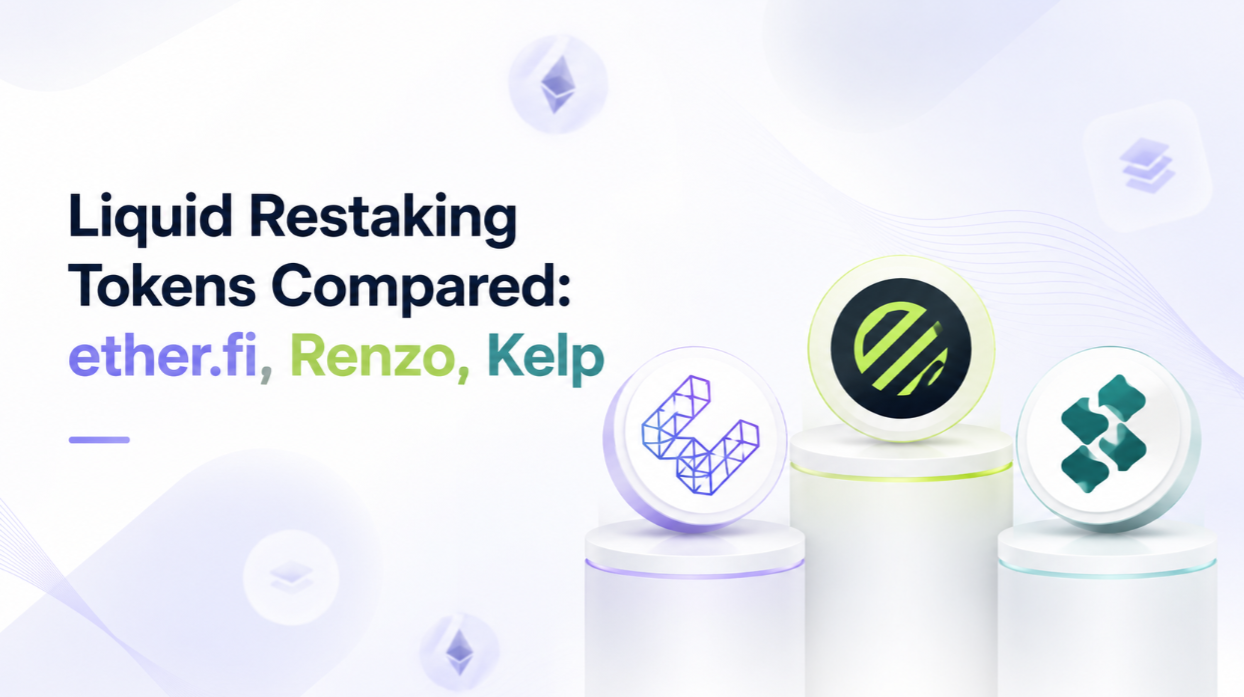
Liquid restaking tokens wrap the operational complexity of restaking into a single liquid asset. Deposit ETH or stETH, receive an LRT, hold it across DeFi while it earns base ETH yield plus restaking rewards. Four LRTs dominate in 2026.
ether.fi (eETH / weETH)
The largest LRT by TVL. Non-custodial — depositors retain their own validator keys via the ether.fi operator network. Earns base ETH yield + EigenLayer AVS yield + ether.fi loyalty points. weETH (the wrapped non-rebasing version) is the version used in DeFi.
Renzo (ezETH)
Aggregator-style: deposits go to multiple operators and AVS automatically. Strong DeFi integration (Pendle, Curve, Aave). Briefly de-pegged 0.7% in April 2024 during a Pendle rotation event — a useful reminder that LRT pegs are not absolute.
Kelp DAO (rsETH)
Backed by the Stader team. Aggregates across multiple LSTs (stETH, mETH, sfrxETH) and restakes them on EigenLayer. Pioneered the "wrapped" LST aggregation approach.
Puffer (pufETH)
Adds anti-slashing tech (Secure-Signer) that aims to prevent slashing events even with buggy operators. Smaller TVL but technical differentiation appeals to users worried about cascading slashing risk.
Side-by-side
- TVL leader — ether.fi > Renzo > Kelp > Puffer.
- Operator transparency — ether.fi (each depositor has assigned validators) > others (pooled).
- DeFi integration depth — Renzo > ether.fi > Kelp > Puffer.
- Anti-slashing tech — Puffer > others.
- Peg history — ether.fi and Kelp have remained tight; Renzo had a brief depeg event.
How yield breaks down
Most LRTs in 2026 deliver 3.2–4.2% net ETH yield + AVS token rewards (variable). Points programs were the primary 2024 driver; in 2026, actual AVS rewards make up a larger share of the realised yield.
Risks to track
- LRT smart contract risk on top of LST risk on top of EigenLayer risk on top of base ETH staking risk.
- Peg risk during stress events — LRTs trade on AMMs and can deviate from underlying.
- AVS slashing cascade — single operator running many AVS amplifies systemic risk.
- Concentration — if one LRT becomes dominant, governance and operator decisions affect a large share of restaked ETH.
For underlying mechanics, see our EigenLayer deep-dive.