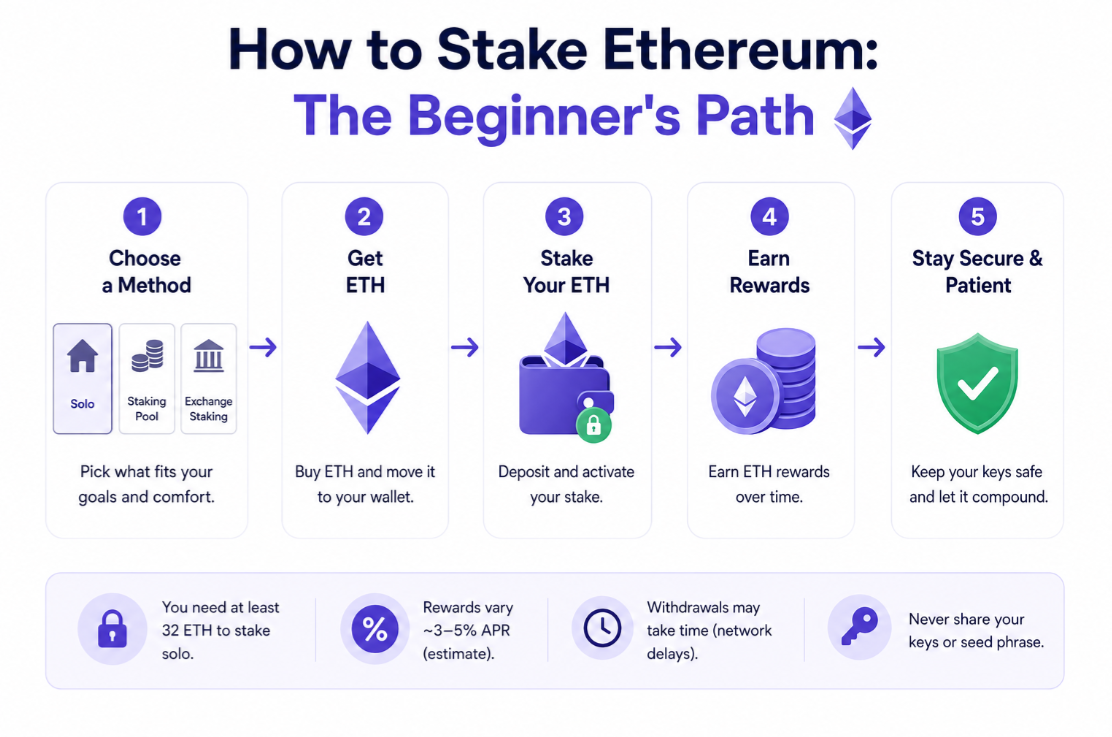
Staking Ethereum pays roughly 3–4% in 2026, and the entry barrier has never been lower. You can stake any amount, at any technical level, with three distinct trade-offs.
Path 1: Liquid staking (easiest)
Deposit ETH into a protocol like Lido, Rocket Pool, ether.fi, or Frax and receive a liquid token (stETH, rETH, eETH) that earns rewards and stays usable across DeFi. No 32-ETH minimum, no slashing risk on you, near-zero technical overhead. Fees: ~10% of yield to the protocol and operators.
Path 2: Centralized exchange staking
Coinbase, Binance (where permitted), and Kraken offer one-click ETH staking. Yields are lower (you pay ~25% to the exchange), but the experience is the simplest possible. Counterparty risk is the trade-off — your ETH is on the exchange.
Path 3: Solo staking
Run your own validator. Requires 32 ETH, a dedicated machine (a small NUC works), and roughly an hour a month of maintenance. You earn the full yield with no protocol fees, but you carry slashing risk if your node misbehaves.
The five questions beginners ask
- How much can I stake? Any amount through liquid staking or a CEX. 32 ETH for solo.
- What is the APR? 3.0–4.5% in 2026, plus MEV rewards (~0.3–0.8%).
- Is my ETH locked? Liquid staking gives you a tradeable token. CEX staking has variable lock-up. Solo staking unstakes in ~2–14 days, depending on the exit queue.
- What is slashing? A penalty for a malfunctioning validator. Solo stakers carry the risk; liquid stakers share it across thousands of operators (extremely low).
- Are rewards taxed? Yes, in most jurisdictions, as income at the time of receipt — and again as capital gains on disposal.
Liquid staking — step by step
- Buy ETH on an exchange or DEX.
- Connect a wallet (MetaMask, Rabby) to stake.lido.fi or rocketpool.net.
- Deposit ETH and receive stETH or rETH 1:1.
- Hold the token to earn yield, or use it in DeFi (Aave, Curve, Pendle).
Liquid staking tokens introduce their own risks. Before depositing anything serious, read our liquid staking tokens guide and our staking solo vs pooled vs liquid comparison.