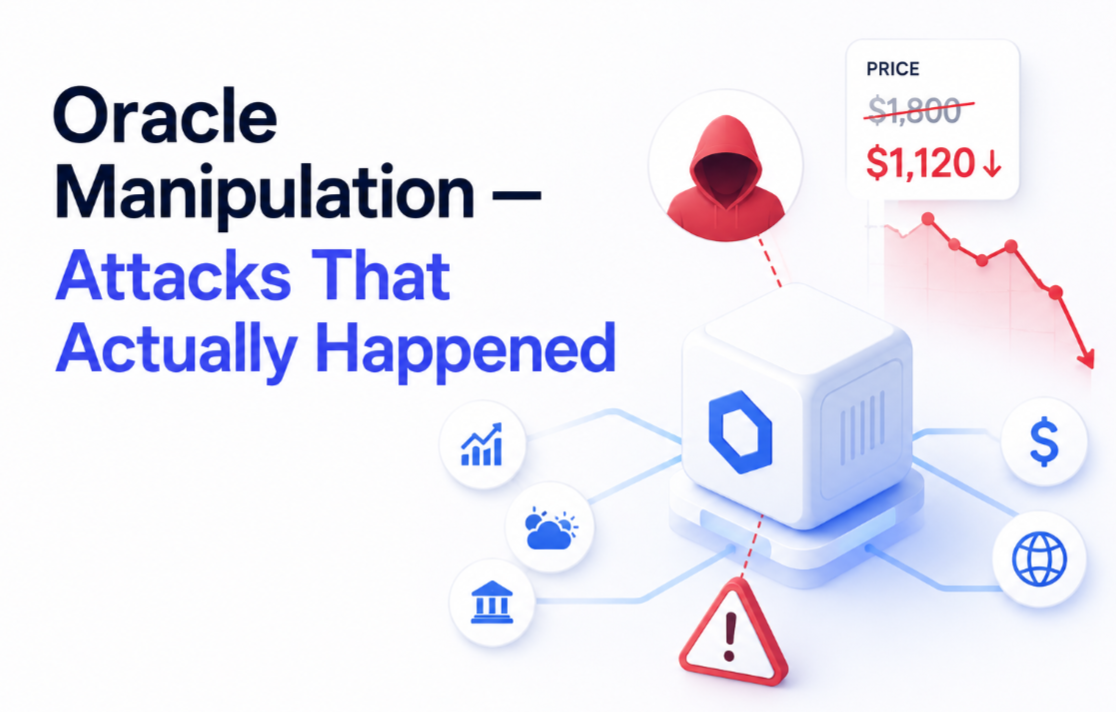
An oracle manipulation attack happens when a protocol relies on a price source that can be influenced within a single transaction, and an attacker moves that source to trick the protocol into believing a false price. The attack works because DeFi protocols make decisions atomically — check the oracle, calculate collateral value, allow the borrow, all in one transaction. If the oracle is manipulable, the whole flow is corrupted.
Oracle manipulation is one of the most-recurring vulnerability classes in DeFi. Understanding the pattern — via real exploits — is required literacy for anyone auditing DeFi protocols or evaluating their risk.
The generic pattern
An oracle manipulation exploit always has three steps:
1. Attacker manipulates the price source (usually a DEX pool with thin liquidity). 2. Protocol reads the manipulated price and treats it as truth. 3. Attacker exploits the mispriced state — borrowing more than they should be able to, minting stablecoins backed by inflated collateral, or triggering favorable liquidations.
The specific mechanism varies by protocol, but the shape is always the same. Manipulate the source, read the corrupted output, extract value.
bZx (February 2020) — the wake-up call
bZx was a margin trading protocol. In February 2020, two separate exploits (five days apart) drained ~$1M combined using flash loan + oracle manipulation.
Attack 1: the attacker took a flash loan of 10,000 ETH, used it to open a large sWBTC position on bZx's margin trading system, which used Uniswap V1 pools as its price source. The trade moved the Uniswap pool's WBTC price significantly. bZx read the manipulated price and let the attacker withdraw more than they should have.
Attack 2: similar pattern with sUSD (Synthetix USD), using a Uniswap V1 pool.
The specifics were novel at the time but the pattern set the template for years of similar exploits. Flash loans provided the capital; small pool sizes made manipulation cheap; single-source pricing made the manipulation credible.
Cream Finance (October 2021) — the escalation
Cream had multiple oracle-related exploits. The October 2021 one drained $130M.
The attacker used a chain of flash loans across multiple lending markets. On Cream, they manipulated the price of yUSD (a Yearn-wrapped stablecoin) by unusual interaction with Curve pools that Cream used as its price source. The manipulated price let the attacker borrow more than the collateral was worth.
Cream had used yUSD's Curve pool price directly as its collateral value. If yUSD looked over-valued in the Curve pool at the moment of borrow, Cream thought the collateral was worth more than it was.
The lesson: pricing exotic assets from single DEX sources is a systematic vulnerability. Cream repeatedly fell to variants of this.
Mango Markets (October 2022) — the perpetual manipulation
Mango was a Solana-based perpetuals exchange. In October 2022, an attacker manipulated the MNGO token price on Mango's oracle (which pulled from thin exchange sources), inflating the value of an MNGO position they held.
With the inflated collateral, they borrowed all of Mango's stablecoin and BTC reserves — $114M total. They then attempted a bizarre "negotiation" with the protocol via a governance vote, ultimately keeping about $47M.
The attacker (Avraham Eisenberg) was later arrested and convicted of fraud in US federal court. The case established a legal precedent that DeFi exploits can be prosecuted as fraud rather than considered "code is law."
The Mango exploit is instructive because it wasn't a "hidden bug" — the manipulability of the MNGO price was known. Mango simply hadn't implemented enough safeguards, and the attacker was willing to put up enough capital to move the price.
Read-only reentrancy on Balancer (2023)
A more subtle variant: Balancer V2 had a view function that returned pool prices, which many protocols used as an oracle. During certain complex transactions, the view function would return a temporarily inconsistent price — the pool's internal state was mid-swap.
Protocols that trusted this view function for their own decisions could be manipulated. Several DeFi protocols were exploited via this mechanism in 2023 for combined ~$10M.
The lesson: even "view" functions can lie during composite transactions. Read-only reentrancy is a category most auditors weren't watching for.
Flash loan amplification
Almost every oracle manipulation attack uses flash loans. Why? Because oracle manipulation requires large capital to move a price, but the capital only needs to be present for one transaction. Flash loans provide unlimited capital for the duration of a single transaction — perfect for oracle manipulation.
Without flash loans, most of these attacks would require the attacker to actually hold the millions or tens of millions of dollars needed to move a price. Flash loans commoditized the capital requirement, making oracle manipulation available to anyone who can code.
What makes an oracle manipulable
The features that make an oracle attackable:
- **Single source**: pulls price from one pool or one exchange. Any manipulation of that source moves the reported price.
- **Spot price**: uses the current price at the moment of query, rather than a time-weighted average.
- **Thin liquidity in the source**: a $100M pool is hard to move; a $500K pool moves 10%+ on a $50K trade.
- **Direct pool price**: reads token balances from a pool rather than executing a swap through it. Prevents the manipulation from being self-limiting.
- **No sanity checks**: doesn't compare against other sources or historical values.
Mitigations
Modern DeFi protocols defend via:
**TWAPs (Time-Weighted Average Prices)**: instead of using the current price, use the average over a window (e.g., last 30 minutes). Manipulating a 30-minute TWAP requires sustained capital deployment, which is much more expensive.
**Multiple oracle sources**: cross-reference two or more independent oracles. If they disagree beyond a threshold, use the median or pause price-sensitive operations.
**Deviation checks**: refuse to accept a price change of more than X% between updates. Legitimate market moves stay in-bounds; manipulation attacks tend to be much sharper.
**Chainlink for primary data**: Chainlink aggregates across many sources with deviation and heartbeat controls, making it much harder to manipulate than a single DEX pool.
**Careful choice of what to price from where**: pricing WETH from its ETH price plus a wrapping check (rather than from a WETH/USDC DEX pool) removes the manipulation vector.
What still gets exploited
Despite years of published defenses, oracle manipulation still happens. Recent (2024-2026) exploits usually involve:
- Newly-launched protocols with insufficient oracle design
- Exotic asset types where good oracle sources don't exist
- Cross-chain price sources with lag or manipulation windows
- LST-heavy strategies where the LST's underlying price is manipulable via redemption arbitrage
The class won't disappear. Any protocol using price data faces the challenge of getting that data safely.
For a user
The concrete implications:
- Don't deposit exotic tokens into lending protocols that price them from single DEX pools.
- Prefer well-established protocols (AAVE V3, Morpho, well-vetted forks) that use Chainlink for major assets.
- Understand that during periods of high volatility, oracle-based decisions (liquidations) may lag by 1-5% behind actual market prices.
- For newly-launched protocols with novel assets: assume oracle risk until proven otherwise.
For anyone auditing protocols, the oracle stack is often where the exploit lives. Understanding the oracle's data flow — from source through aggregator to consumer — is a required part of any DeFi review.
The takeaway
Oracle manipulation attacks work because DeFi protocols need to answer "what is this worth" atomically, and the "worth" is often defined by a source that can be moved with capital. Every mitigation makes the attack more expensive; none eliminates the class.
For serious DeFi participants, the question isn't "does oracle manipulation still happen?" It's "what oracle does this protocol use, and how does it defend?"