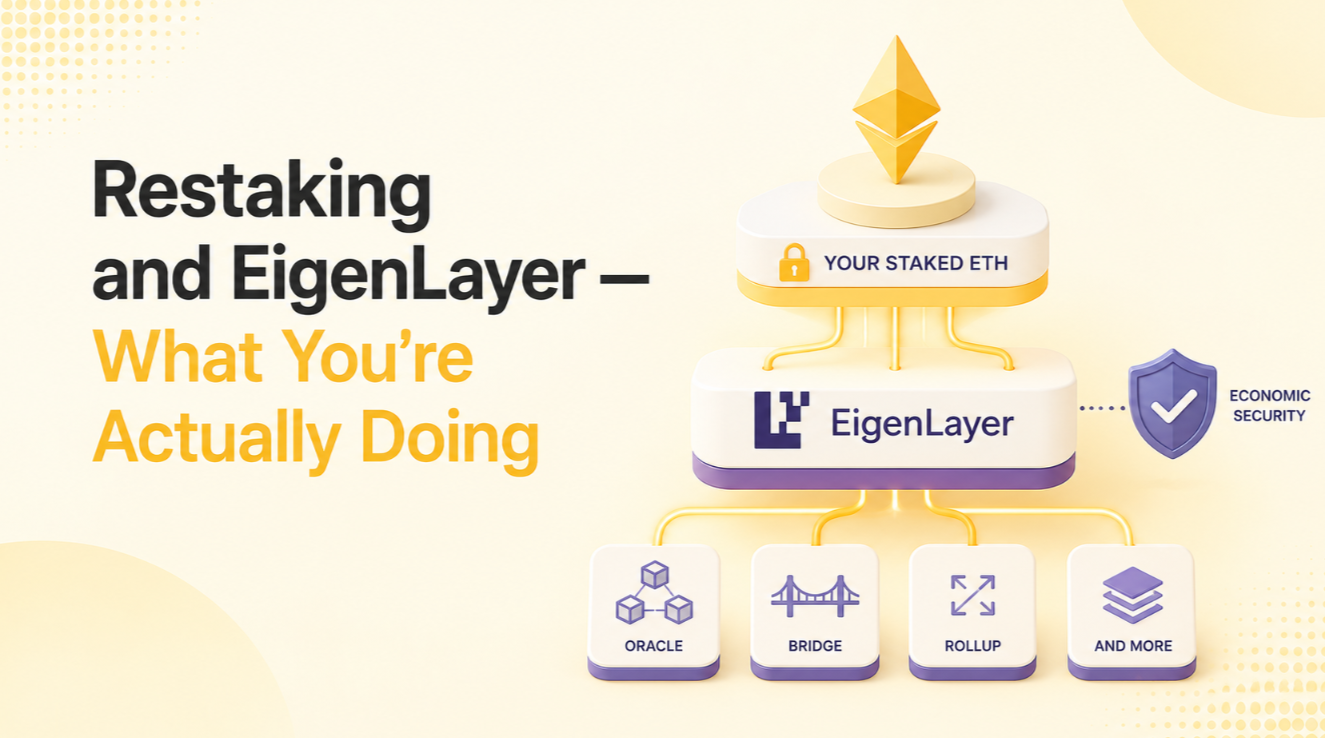
Restaking is the mechanic that lets your already-staked ETH secure additional protocols beyond Ethereum itself. If a protocol needs economic security (a bridge, an oracle network, a rollup) but doesn't want to bootstrap its own staked token, it can rent security from Ethereum's validator set via restaking. EigenLayer is the dominant restaking protocol, and understanding what you're really doing when you restake is essential before locking up capital.
The core idea
Ethereum validators stake 32 ETH each and earn staking yield. That 32 ETH is at risk — validators who behave badly (double-signing, going offline, etc.) get "slashed," losing part or all of their stake.
Restaking extends this concept: what if the same 32 ETH could also be at risk for the good behavior of a different protocol? An oracle network could say "we require our nodes to also be Ethereum validators. If our node lies about a price, we slash both their Ethereum stake and give the slashed ETH to whoever we're protecting."
Now that 32 ETH is providing security to two things simultaneously — Ethereum plus the oracle network. The validator earns Ethereum staking rewards plus additional revenue from the oracle network. The oracle network gets meaningful economic security without needing its own token.
This is restaking. EigenLayer is the coordination protocol that makes it work at scale.
How EigenLayer works
EigenLayer has three main parties:
**Restakers**: users who deposit ETH (or LSTs like stETH, rETH) into EigenLayer contracts. Their deposits become eligible to be "restaked" onto Actively Validated Services.
**Operators**: entities that run the actual infrastructure. Restakers delegate their stake to operators who agree to run specific AVS software.
**AVSs (Actively Validated Services)**: the protocols that consume restaked security. Data availability layers (EigenDA), oracle networks, cross-chain bridges, coprocessors — anything that needs economic security.
The flow:
1. You deposit ETH/LST into EigenLayer. 2. You delegate your restaked position to an operator. 3. The operator opts into running specific AVSs. 4. AVSs pay the operator (and by extension, you) for the security they consume. 5. If the operator misbehaves on an AVS, your restaked ETH can be slashed.
What you actually earn
Restaking rewards come from:
- Base Ethereum staking yield (~3-5% APR)
- Additional AVS rewards (variable, currently ~1-5% APR depending on which AVSs your operator serves and what they pay)
- Restaking-token airdrops (some AVSs airdrop their own tokens to early restakers)
- EigenLayer's own governance token (EIGEN) rewards
Total rewards for restakers in 2024-2025 averaged 5-15% APR depending on operator and AVS selection. Rates have compressed as more capital entered, and the "airdrop farming" phase is winding down.
The risk you're taking
The core additional risk beyond normal staking: additional slashing conditions from AVSs.
Every AVS defines its own slashing conditions. If your operator opts into 5 AVSs, you're exposed to slashing on any of them. Bad behavior on one AVS can result in you losing capital, even if the underlying Ethereum staking is fine.
Concretely:
- **Operational risk**: your operator makes a mistake operating an AVS, gets slashed
- **AVS bug risk**: the AVS itself has a bug that triggers spurious slashing conditions
- **AVS governance risk**: AVS governance changes slashing rules in ways that suddenly threaten operators
- **Contagion risk**: if EigenLayer or a major AVS gets exploited, all restaked capital may be affected
Most restakers accept these risks in exchange for the additional yield. Whether the yield adequately compensates for the risk is an active debate.
The Liquid Restaking Tokens (LRTs) layer
Just as LSTs wrap staked ETH into tradeable tokens, LRTs wrap restaked positions into tradeable tokens. Instead of directly interacting with EigenLayer, you can deposit into a LRT protocol that manages the restaking on your behalf.
Major LRTs:
- **eETH (ether.fi)**: largest LRT, aggressive on AVS selection.
- **rsETH (Kelp)**: also large, similar model.
- **weETH (wrapped eETH)**: non-rebasing version for DeFi integration.
- **pufETH (Puffer)**: differentiator is native EigenLayer positions + Puffer's own validator infrastructure.
LRTs add another layer of abstraction (and risk) between users and the underlying restaked ETH. You're now trusting: Ethereum + LST issuer + EigenLayer + LRT protocol + operators + AVSs. That's a lot of stacked dependencies.
The upside is convenience — you can hold weETH and get restaking exposure plus DeFi usability without managing operators or AVS choices yourself.
The composability question
Critics of restaking point out that it creates deeply interconnected risk. If your restaked ETH is slashed on one AVS, and that ETH is also collateral in an LRT that's used in an AAVE lending market that's used in a leveraged strategy — the slashing propagates through the whole stack.
Ethereum's design has always tried to keep validator responsibilities minimal to prevent this kind of cascading failure. Restaking explicitly opts into more responsibility, and the concern is that a major slashing event could destabilize both EigenLayer and the DeFi protocols built on top of restaked capital.
Vitalik Buterin has been publicly cautious about this. The Ethereum Foundation has been careful to keep Ethereum's own security model separate from EigenLayer's — even though the two are deeply connected via shared capital.
The centralization angle
If EigenLayer becomes systemically important — if AVSs replacing existing infrastructure (oracles, bridges, DA) all depend on it — then EigenLayer's decisions matter for the broader ecosystem. That's a level of coordination power that Ethereum has historically tried to avoid.
Similarly, if certain operators end up running many AVSs, they become concentration points for the entire system.
These are governance concerns rather than technical ones. Whether they materialize depends on how the ecosystem evolves.
For a user considering restaking
Practical guidance:
- If you want yield above LST rates and understand the additional risks: restaking or LRTs can be reasonable.
- If you want simplicity and don't want to research operators: LRTs are the accessible path.
- If you're highly risk-averse or want to minimize dependencies: just hold LSTs (or self-stake) without restaking.
- Don't restake more than you're willing to lose — slashing events can be significant.
- Diversify across operators and AVSs if you're at meaningful scale.
The restaking ecosystem is still young. What looks like reasonable yield today may look inadequate compensation after the first major slashing event. Historical returns aren't guarantees; the risks haven't been fully stress-tested.
Where restaking is heading
Ethereum's protocol has been evolving to accommodate restaking more explicitly (via EIPs that allow safer validator behavior). AVSs continue to launch — the theory is that many services will migrate to rented security.
In practice, whether this creates lasting value or just a temporary "yield tourism" wave depends on whether AVSs generate real revenue that justifies the security they consume. If AVSs are just paying restakers with their own token emissions (as many are in 2024-2026), the model doesn't create durable value — it's just a way to distribute governance tokens.
The next few years will determine whether restaking is a permanent primitive or a cycle-specific phenomenon.