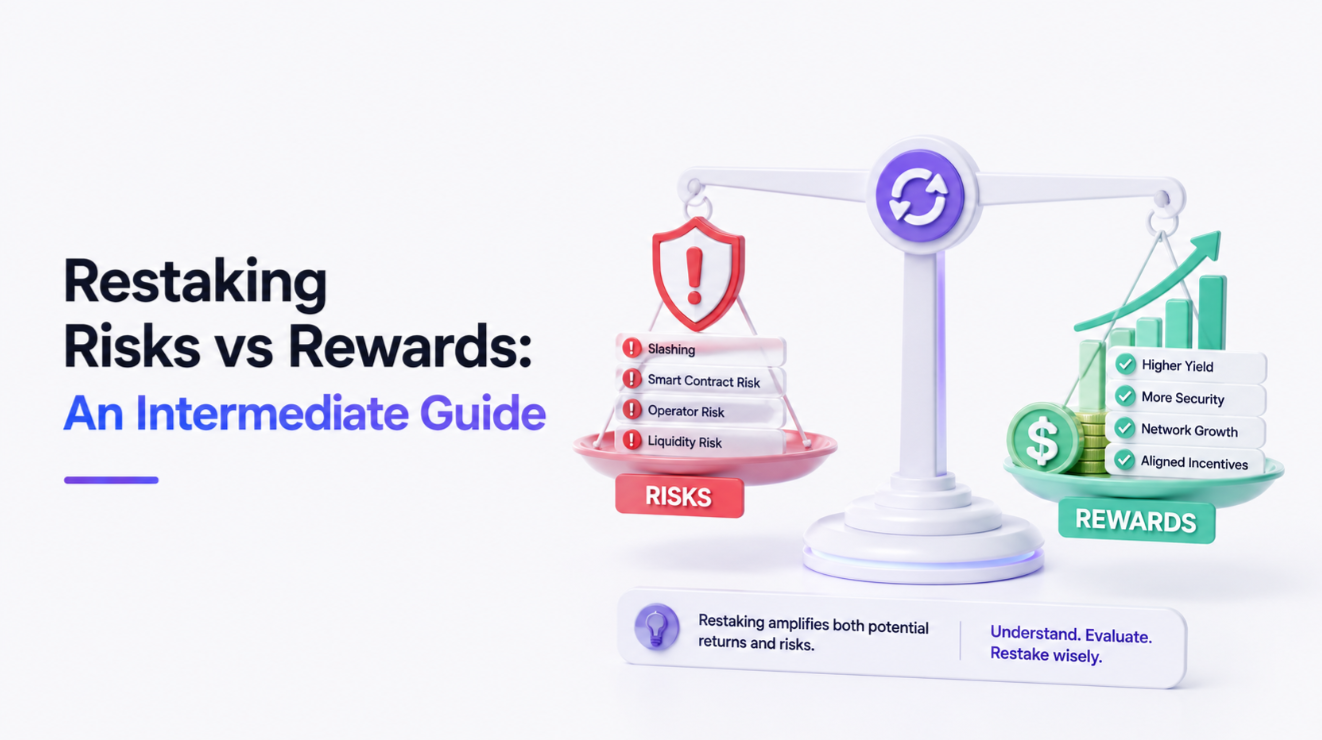
Restaking sounds simple: earn extra yield on top of staking. The reality is more layered, and the marketing is loudest exactly when the structural risks are highest. Here is the honest, intermediate-level take.
What you are actually doing
You deposit ETH or a liquid staking token into EigenLayer (or Symbiotic, or Karak). That same ETH that secures Ethereum now also secures additional protocols — bridges, data layers, oracles. You earn extra rewards in exchange for taking on additional slashing exposure.
The realistic yield stack
- Base ETH staking via LST: ~3.0–3.5%.
- EigenLayer AVS rewards (in 2026): 0.5–2.5% in AVS-native tokens.
- Points (still ongoing): unclear final value.
- All-in expected: 3.5–6%, with most of the upside in AVS tokens whose value is volatile.
The four real risks
- Slashing cascades — Your operator misbehaves on one AVS; multiple AVS slash; your principal takes a hit.
- Smart contract risk — Each layer (LST + EigenLayer + LRT wrapper) is a separate codebase.
- Peg risk — LRTs trade on AMMs. During stress, they can dip 0.5–2% below redemption.
- Value risk — AVS reward tokens are often inflationary with no clear value capture.
When restaking is reasonable
- You already hold LSTs and accept their risk profile.
- You can model worst-case slashing exposure and remain within risk budget.
- You diversify across multiple LRTs and AVS operators.
- You treat AVS token rewards as speculative — not as principal yield.
When to wait
You are new to staking. You hold less than a meaningful position. You cannot afford the cognitive overhead of tracking multiple layers of risk. You are uncomfortable with smart-contract exposure stacked three or four deep. Restaking will still be there next year with more maturity.
See our EigenLayer deep-dive and LRT comparison.