Solana's wallet field has consolidated. Three apps dominate in 2026 — Phantom, Backpack, and Solflare — each with a distinct philosophy. Here is the honest comparison.
Phantom: the default
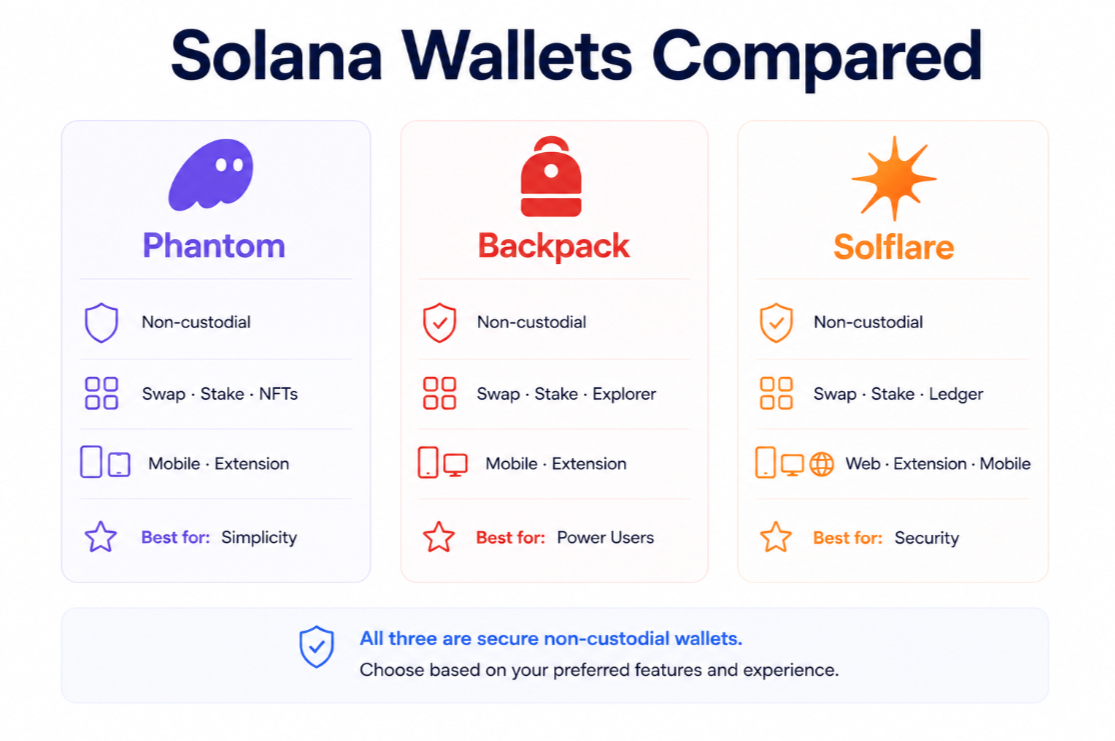
Phantom remains the most-downloaded Solana wallet, with 8M+ active users. Clean UX, built-in swap aggregator, NFT gallery, and full support for Ethereum, Polygon, Base, Sui, and Bitcoin Ordinals. Best for users who want a single wallet across most major chains.
Backpack: the Solana power-user choice
Backpack ships with xNFTs (executable NFTs that run mini-apps inside the wallet), an exchange built into the app, and the best Solana-native UX of the bunch. Multi-chain support is narrower than Phantom's but expanding. Favored by Solana DeFi users.
Solflare: the long-runner
Solflare has been around longest, supports the broadest hardware wallet ecosystem (Ledger, Keystone, Trezor), and integrates deeply with native staking and SOL liquid-staking tokens. The UX is more functional than playful — well suited to validators and serious stakers.
Side-by-side
- Multi-chain breadth — Phantom > Backpack > Solflare.
- Hardware wallet support — Solflare > Phantom > Backpack.
- NFT experience — Backpack (xNFTs) > Phantom > Solflare.
- Built-in swap — Phantom > Backpack > Solflare.
- Open-source — Backpack > Solflare > Phantom (closed-source).
Security across all three
All three are non-custodial — your seed phrase never leaves your device. All three integrate Blowfish or a similar transaction simulator that warns about drainers and suspicious approvals. None protects you from signing what you don't read; the discipline of reviewing each pop-up still matters.
Which one should you install?
Most beginners do well with Phantom for its polish and reach. Backpack suits Solana power users and NFT collectors who like xNFTs. Solflare suits stakers and anyone wanting deep hardware wallet support.
For more, see our wallet setup walkthrough and our hardware wallet comparison.