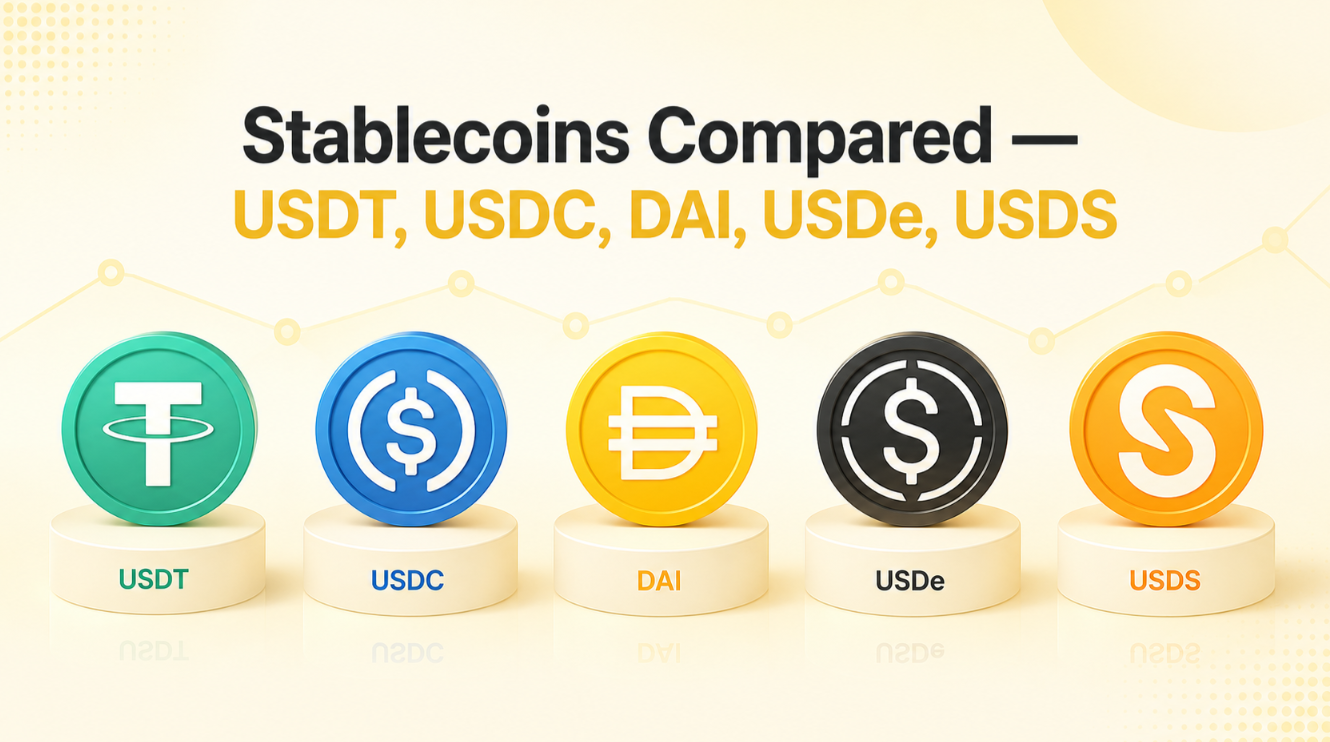
Stablecoins are the connective tissue of crypto. Trading, lending, remittance, DeFi yield — most of it flows through stablecoins. But "stablecoin" hides enormous variation in how the peg is maintained, what backs the token, and what risks the holder is exposed to. Understanding the differences between USDT, USDC, DAI, USDe, and USDS is the difference between "I hold digital dollars" and "I actually know what I hold."
USDT (Tether) — the incumbent
Issuer: Tether Limited (private company, headquartered in Hong Kong and British Virgin Islands).
Peg mechanism: fiat-backed. Tether claims to hold reserves (primarily US Treasuries plus cash equivalents) equal to circulating USDT.
Circulation: ~$140B+ as of 2026, the largest stablecoin by far.
Where it's used: dominates centralized exchange trading pairs (BTC/USDT, ETH/USDT, most altcoins/USDT), Asian remittance markets, and much of the retail on-chain trading in Ethereum, Tron, and other chains.
Strengths: universal acceptance, deep liquidity everywhere, works on any chain (Ethereum, Tron dominance, plus deployments on essentially every major chain).
Weaknesses: opaque reserves, historical questions about whether reserves fully backed circulating supply, legal issues (NYAG settlement 2021), depends on Tether Ltd. as an unregulated (in most jurisdictions) counterparty. Historically criticized for using "commercial paper" and other non-cash instruments as reserves — has since shifted more toward US Treasuries under regulatory pressure.
For most retail crypto use in Asia and CEX trading globally, USDT is the default. For sophisticated users, the counterparty risk is real.
USDC — the regulated alternative
Issuer: Circle (US-based, publicly traded 2024).
Peg mechanism: fiat-backed with heavy US regulatory compliance. Reserves audited monthly, held at named US banks and in US Treasuries.
Circulation: ~$40B as of 2026 (fluctuates with regulatory conditions and market cycles).
Where it's used: dominates DeFi (most Aave/Compound stablecoin liquidity is USDC), US-based crypto usage, institutional adoption. Native on Ethereum, deployed on most L2s and other chains via Circle's native issuance.
Strengths: transparent reserves (monthly attestations plus 2024's public company status), regulated in the US, blessed by most US institutional players, natively issued on many chains (not "bridged" USDC).
Weaknesses: KYC/regulatory risk — Circle can freeze specific addresses at government request (has done so). Depegged briefly in March 2023 during Silicon Valley Bank crisis because ~8% of reserves were at SVB. Recovered when SVB was bailed out.
USDC is the "safe" stablecoin for DeFi users who value transparency and regulatory compliance over privacy or maximum decentralization.
DAI — the decentralized OG
Issuer: MakerDAO (decentralized protocol).
Peg mechanism: crypto-backed, algorithmically maintained. Users deposit collateral (ETH, WBTC, LSTs, etc.) into Maker vaults and mint DAI against it. If collateral value drops below the required ratio, positions get liquidated.
Circulation: ~$5-7B as of 2026 (varies with DeFi cycle).
Where it's used: DeFi natively, particularly in protocols that want a stablecoin without CEX-controlled centralization.
Strengths: no central issuer that can freeze accounts. Backing is verifiable on-chain (Maker's vault positions are public). Governance is (theoretically) decentralized via MKR token holders.
Weaknesses: peg maintenance is complex and has failed briefly (Black Thursday 2020, sub-$1 during banking crises). Backing has increasingly shifted to include RWAs (real-world assets like US Treasuries via off-chain custody), which reintroduces some centralization/regulatory risk. Complexity of the system means fewer users understand what actually backs it.
DAI is the choice for users who prioritize decentralization and are willing to accept complexity.
USDe (Ethena) — the delta-neutral
Issuer: Ethena Labs.
Peg mechanism: "synthetic dollar" backed by ETH (or LST) long positions hedged with short perpetual futures. The idea: hold $100 of ETH, short $100 of ETH perps — you're delta-neutral in dollar terms while earning funding rates. USDe is claims on this position.
Circulation: ~$5-10B as of 2026 (grew fast in 2024-2025).
Where it's used: DeFi protocols wanting stablecoin yield (USDe stakers earn the funding rate revenue), some CEX integrations.
Strengths: yield-bearing (holders earn the perp funding rate, which historically averages 5-15% APR), doesn't depend on traditional banking, backing is on-chain and off-chain-hedged.
Weaknesses: funding rates can go negative during bear markets (holders lose money), depends on continued availability of large perp markets, custody of hedge positions has some centralization (uses CEX custody with segregation). Novel enough that stress-test history is thin.
USDe is the choice for DeFi users who want yield above what USDC/DAI offer and understand the funding-rate-dependent design.
USDS (formerly DAI, MakerDAO's rebranded version)
MakerDAO rebranded significant chunks of its infrastructure as "Sky" in 2024, with USDS being the successor to DAI. DAI itself continues to exist and remains interchangeable with USDS 1:1 (via Maker's converters), but USDS is positioned as the new flagship stable.
USDS is essentially the same mechanism as DAI — vault-backed, algorithmically pegged — with different branding and some governance changes.
For most users, USDS and DAI are the same thing. The distinction matters if you're deep in Maker/Sky governance.
Compared: pegs and depegs
Historical depeg events:
- USDT: brief small depegs during CEX collapses (FTX 2022 briefly dropped to $0.98). Generally recovers within hours.
- USDC: SVB crisis 2023 dropped to $0.87 for ~24 hours. Recovered when SVB was bailed out.
- DAI: closely tracks USDC (because much of DAI's backing is USDC-adjacent). Depegged with USDC during SVB.
- USDe: has traded within ~0.5% of peg since launch. Not stress-tested against a major crisis yet.
- USDS: same as DAI.
None have permanently lost peg (though algorithmic stablecoins like UST/Terra have — different category).
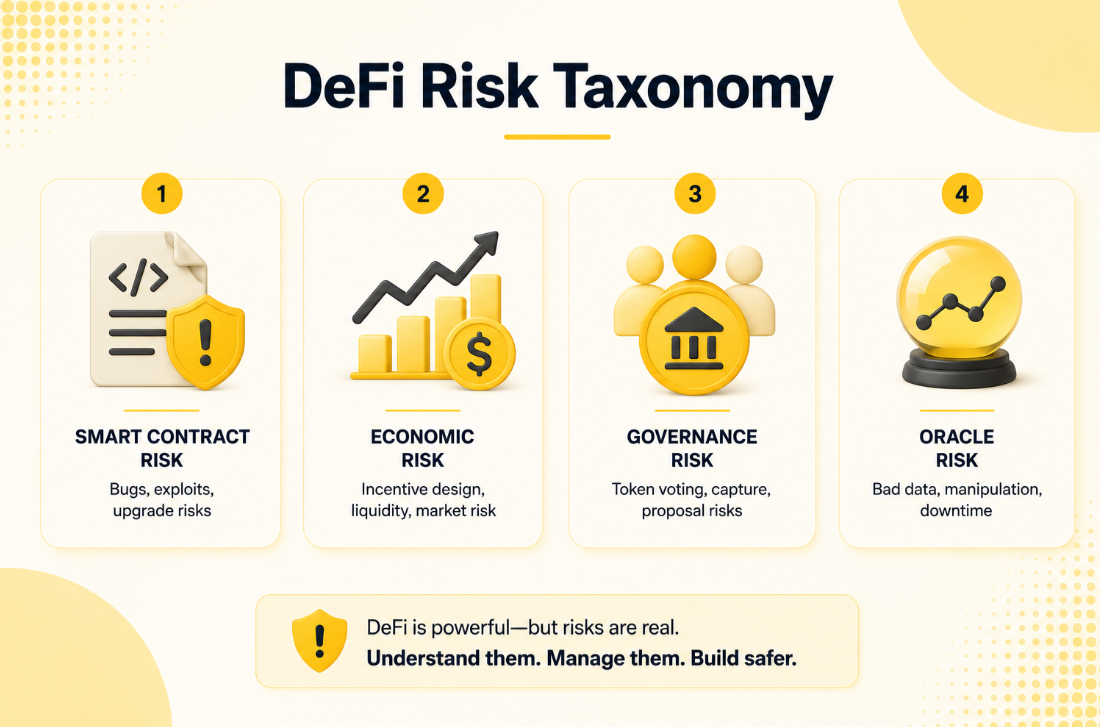
Risk categories
**Custody risk**: USDT and USDC depend on off-chain custody at named banks and in Treasuries. Regulatory or banking failure at the issuer level is the primary risk.
**Smart contract risk**: DAI, USDe, USDS depend on smart contracts working correctly. Bugs in Maker's or Ethena's contracts could cause bad debt.
**Backing quality risk**: DAI has some backing in RWAs (via off-chain custody) — introduces intermediary risk. USDe's backing quality depends on the health of the perp markets it uses for hedging.
**Regulatory risk**: USDT and USDC most exposed to future regulatory action (freezing, mandatory disclosures, forced redemptions). DAI and USDe less exposed but not immune.
**Counterparty risk**: USDT and USDC depend on the issuers being honest and not fleeing with reserves. Long history without this happening but the risk is non-zero.
For a user
Choosing which stablecoin to hold:
- For CEX trading: USDT is universally accepted.
- For DeFi: USDC is the safest widely-accepted choice.
- For decentralization purism: DAI (or USDS).
- For yield: USDe or its staked variant sUSDe.
- For maximum diversification: hold a mix, don't concentrate in any single stablecoin.
For amounts significant to your net worth, spreading across USDC and USDT (with maybe a smaller allocation to DAI) is a reasonable default. Concentration in any single issuer creates concentration risk you don't need to take.
The direction of travel
Stablecoin regulation has been tightening. The US GENIUS Act (2024, gradually taking effect) sets specific requirements for reserves, disclosure, and consumer protections. Circle (USDC issuer) is fully compliant. Tether has been adapting but remains partially outside the US regulatory perimeter.
Novel designs (USDe delta-neutral, plus various emerging ones) continue to appear. Each promises solutions to problems with existing designs but introduces its own novel risks. As with any new financial instrument, stress-test history is what separates "clever design" from "battle-tested."
For 2026, USDC and USDT dominate. DAI/USDS holds a persistent DeFi share. USDe has carved out a yield-seeking niche. The rest is long-tail experimentation.