AAVE is the largest lending protocol in DeFi, with tens of billions of dollars in supplied and borrowed positions across Ethereum and multiple L2s. Understanding how it works — the interest rate model, the health factor, liquidation mechanics — is a required piece of DeFi literacy, and once you understand AAVE, you understand most of the lending protocols that came after it (Compound, Morpho, Spark, etc.).
The core loop
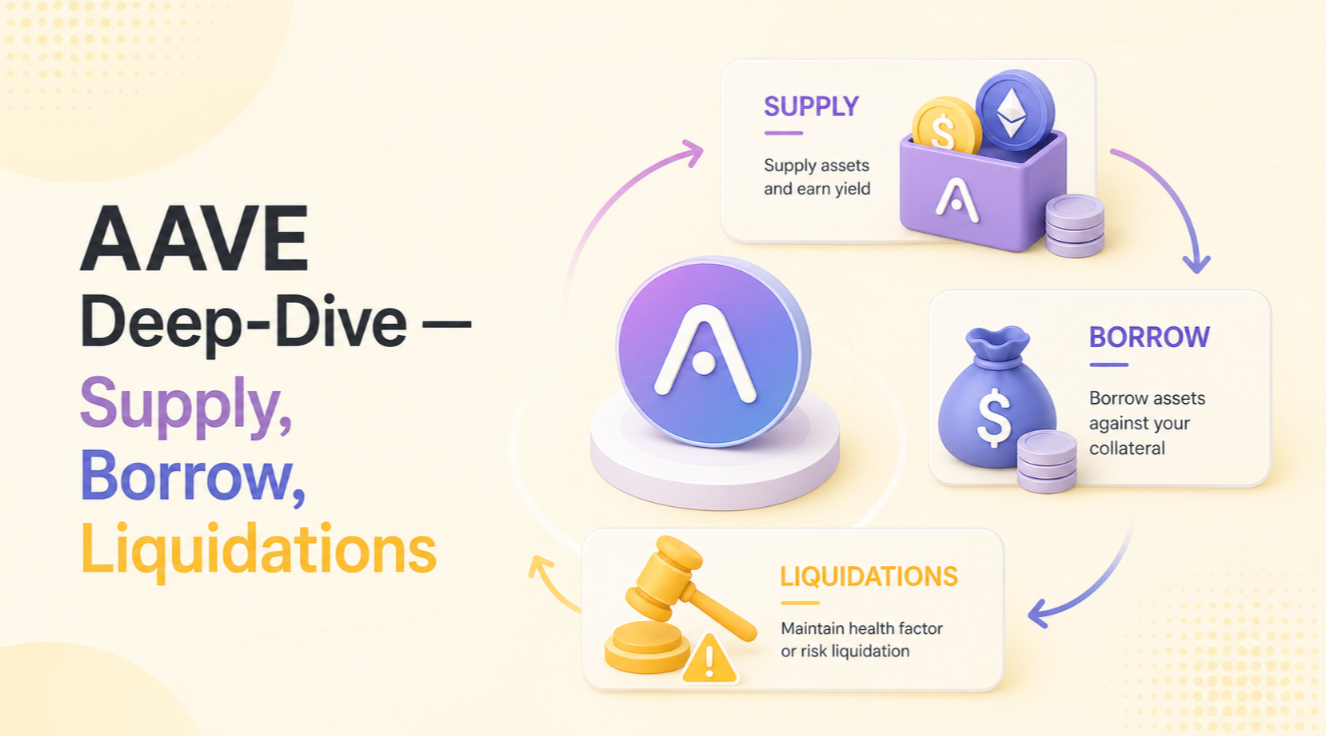
AAVE has two user actions:
**Supply**: deposit an asset into an AAVE pool. You earn interest on your deposit, denominated in the same asset. You receive aTokens (like aUSDC for USDC deposits) that represent your position and can be used elsewhere in DeFi.
**Borrow**: take out a loan against your supplied collateral. You pay interest on the borrowed amount. The maximum you can borrow depends on the collateral value and the loan-to-value ratio (LTV) of the collateral asset.
Suppliers earn what borrowers pay. AAVE takes a small cut as reserve factor (typically 10-20% of interest revenue).
The interest rate model
Interest rates on AAVE are algorithmic, based on utilization:
Utilization = total borrowed / total supplied
For each asset:
- At low utilization: interest rates are low (attracts borrowers)
- As utilization increases: rates rise gradually
- Above the "optimal utilization" (typically 80-90%): rates rise sharply (kick-in mechanism)
- At 100% utilization: no more borrowing possible; suppliers may face delays withdrawing
This model creates a natural equilibrium. If borrowing demand spikes, rates rise, which attracts more suppliers and discourages new borrowers, bringing utilization back to sustainable levels.
Different assets have different rate parameters. Stablecoins have higher optimal utilization (85-90%). Volatile assets like ETH have lower (70-80%). This reflects the different risk profiles.
Health factor — the liquidation trigger
Every borrower on AAVE has a health factor, calculated as:
Health Factor = (collateral value × liquidation threshold) / borrowed value
If health factor drops below 1, the position becomes liquidatable. Anyone can call the liquidation function to repay part of the debt and receive collateral at a discount (typically 5-10%).
Concrete example:
- You supply 10 ETH ($20,000) with an LTV of 80% and liquidation threshold of 82.5%.
- You borrow $10,000 USDC.
- Health factor = ($20,000 × 0.825) / $10,000 = 1.65.
- If ETH drops to $1,500, collateral value drops to $15,000. HF = ($15,000 × 0.825) / $10,000 = 1.24. Still safe.
- If ETH drops to $1,300, HF = ($13,000 × 0.825) / $10,000 = 1.07. Getting dangerous.
- If ETH drops to $1,213, HF ≈ 1.00. Liquidation eligible.
A good rule of thumb: keep health factor at 1.5 or above during normal market conditions. Below 1.3 is risky. Below 1.1 is on the edge.
Liquidations in practice
When your health factor drops below 1, liquidator bots race to be first. The liquidator:
1. Repays a portion of your debt (up to 50% typically — "close factor"). 2. Receives the equivalent value of your collateral, plus a bonus (5-10%). 3. Your position is reduced but not closed. Health factor recovers.
For you as the liquidated user: you lose collateral equal to the debt repaid plus the bonus. This is real loss — a $10,000 liquidation costs you $10,500-11,000 in collateral.
Liquidations are competitive. Multiple bots watch every borrower's health factor. During market crashes, priority fees spike as bots compete for the same liquidations.
The eMode innovation
AAVE V3 introduced "efficiency mode" (eMode). For correlated assets (stablecoins with each other, or ETH-LST pairs), eMode allows much higher LTV — up to 97% for stablecoin-to-stablecoin borrowing.
This makes AAVE competitive with more specialized markets for looping strategies (e.g., borrow USDC against USDT to earn a spread) or LST leverage (borrow ETH against wstETH to loop restaking rewards).
Using eMode requires all collateral and debt to be in the same category. You can't mix eMode positions with regular positions in the same account.
Isolation mode
Also new in V3: isolation mode for risky assets. An asset in isolation mode:
- Can only be used as collateral for borrowing specific whitelisted assets (usually stablecoins).
- Has a debt ceiling that limits how much can be borrowed against it.
- Can't be combined with other collateral in the same position.
This lets AAVE list newer or riskier assets as collateral without exposing the whole protocol to their risks.
Multi-chain AAVE
AAVE is deployed on Ethereum, Polygon, Arbitrum, Optimism, Base, and other chains. Each deployment is a separate protocol with its own liquidity, rates, and asset list. Cross-chain positions are not supported natively — your Ethereum AAVE position and your Arbitrum AAVE position are separate.
Some assets are available on multiple chains. Rates and utilization vary — sometimes stablecoin borrowing on Arbitrum is much cheaper than on Ethereum due to different demand dynamics.
GHO — AAVE's stablecoin
AAVE launched GHO in 2023 as its own overcollateralized stablecoin. GHO is minted by AAVE users borrowing against collateral, similar to DAI on MakerDAO.
GHO offers borrowers a fixed borrow rate (rather than variable), and its issuance is capped. It's smaller than DAI in circulation but has grown steadily and represents AAVE's ambitions to be more than a lending protocol.
Common strategies
**Simple borrow**: supply an appreciating asset (ETH, WBTC), borrow a stablecoin, use the stablecoin for spending or investing elsewhere.
**Looping (leverage)**: supply USDC, borrow USDC (via a different asset intermediary), redeposit, repeat. This creates leveraged exposure to interest rate differentials or asset appreciation.
**LST looping**: supply wstETH, borrow ETH, swap ETH for wstETH, redeposit, repeat. Amplifies staking yield.
**Rate arbitrage**: borrow at one protocol, supply at another where rates are higher. Difficult in practice because rate differences are usually competed away.
Risks to remember
- **Liquidation risk**: sudden price drops can liquidate your position. Manage health factor conservatively.
- **Oracle risk**: bad price data can trigger unfair liquidations or unfair borrows.
- **Smart contract risk**: AAVE has been well-audited but is still smart-contract code.
- **Utilization spike risk**: sudden borrower exodus can push utilization to 100% and delay withdrawals.
- **Governance risk**: AAVE governance can change parameters (LTV, liquidation threshold, interest curve). Changes are usually well-telegraphed but not always what individual users want.
For a user
AAVE is one of the safer places to do DeFi lending in 2026. Well-audited, battle-tested, deep liquidity, mature governance. If you're new to DeFi lending, AAVE (or its main competitor Morpho) is the reasonable starting place.
Practical habits:
- Keep health factor >1.5 for volatile collateral.
- Understand eMode before using it — the higher LTV is real leverage.
- Check the specific asset's parameters before borrowing/supplying — they vary.
- Monitor interest rates — sudden spikes can eat profits from your position.
- Don't assume the DeFi world is bug-free just because AAVE has been safe so far.
The mechanics of AAVE transfer to most lending protocols. Once you understand supply/borrow/health factor/liquidation, you understand Compound, Morpho, Spark, and the rest with only minor adjustments.