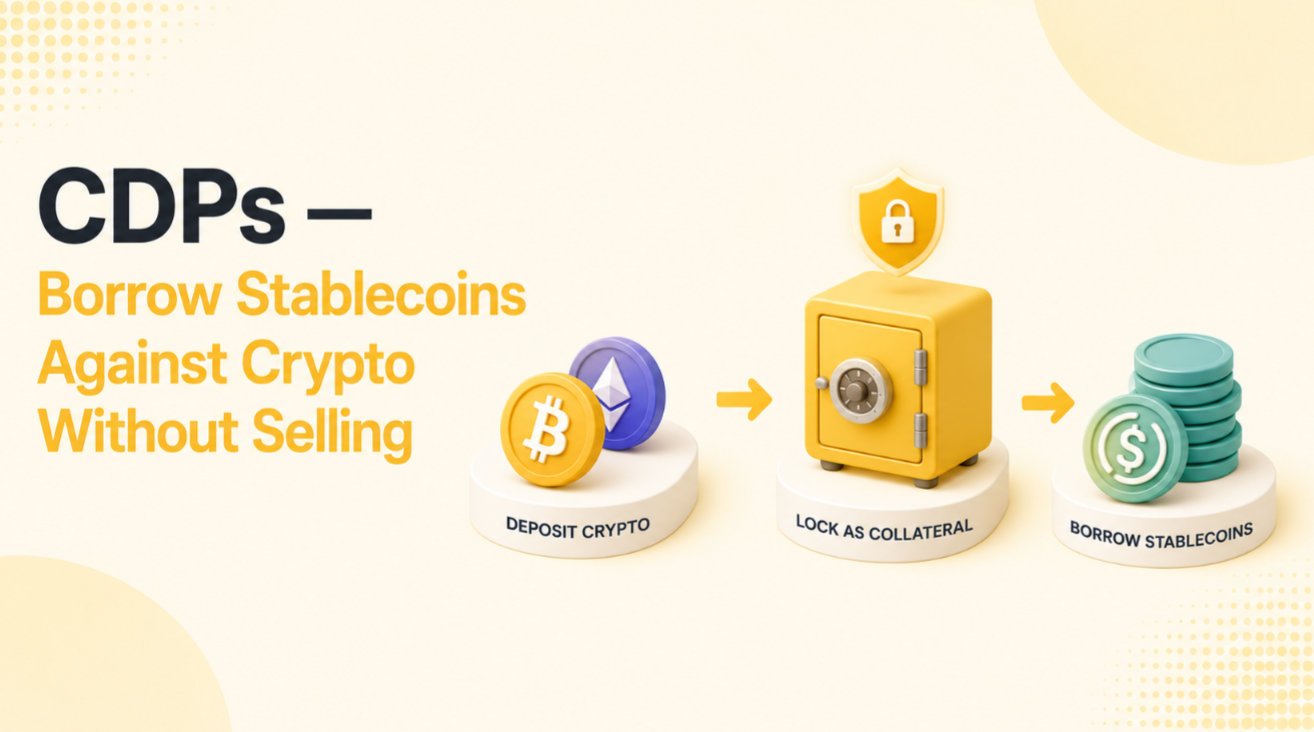
A Collateralized Debt Position (CDP) is a vault where you lock crypto collateral and mint stablecoins against it. The mechanism was pioneered by MakerDAO to issue DAI and remains one of the foundational DeFi primitives. Understanding CDPs — how they work, why people use them, and where they fail — is required background for anyone who wants exposure to leveraged DeFi strategies or self-issued stablecoin liquidity.
The core mechanic
You have $10,000 of ETH. You want liquidity — cash to spend, invest elsewhere, or leverage — but you don't want to sell your ETH (maybe you think it will go up, or you don't want to trigger a taxable event).
Solution: open a CDP.
1. Deposit your $10,000 of ETH into a Maker vault. 2. Mint DAI against it, up to a certain limit (typically 50-70% of collateral value). 3. You now hold DAI (which is a stablecoin ≈ $1) plus you still own the underlying ETH. 4. To close the CDP, repay the DAI plus a small stability fee, and withdraw your ETH.
The DAI is essentially a loan against your ETH. As long as the DAI is outstanding, your ETH is locked in the vault. If ETH price drops enough that your collateral is no longer sufficient, your vault gets liquidated.
Maker (Sky) — the flagship CDP protocol
MakerDAO launched in 2017 and pioneered the CDP model. In 2024, it rebranded significant portions of its infrastructure as "Sky" (with USDS as the new stablecoin), but DAI and legacy Maker continue to operate.
Currently supported collateral types include:
- ETH (via ETH-A, ETH-B, ETH-C vaults with different parameters)
- wstETH (Lido-staked ETH)
- WBTC (wrapped Bitcoin)
- USDC (yes, stablecoin backing stablecoin — for arbitrage purposes)
- Various tokenized real-world assets (RWAs) — US Treasuries mostly
- Uniswap V3 LP positions (as of a certain point)
Each collateral type has:
- Debt ceiling (max total DAI mintable against it)
- Liquidation ratio (minimum collateralization required)
- Stability fee (interest rate on outstanding debt)
The stability fee
Unlike AAVE's variable rate model, Maker uses a stability fee — the interest rate on your outstanding DAI/USDS debt. Set by MakerDAO governance, typically 3-10% annualized in 2026.
The stability fee is not paid continuously. It accrues to your debt and must be paid when you repay the loan. If you borrow 1,000 DAI at 5% stability fee for one year, you must repay ~1,050 DAI to close the position.
Stability fees are how Maker earns revenue. This revenue funds MakerDAO's operations plus (theoretically) buybacks of MKR governance token.
Liquidation mechanics
If your CDP's collateral value drops below the minimum ratio, it can be liquidated:
1. Your collateral is auctioned off to repay your debt. 2. Auction typically starts at a premium price and decreases over time until a buyer takes it. 3. Any excess after debt + liquidation penalty is returned to you. 4. If the auction can't cover the debt fully (rare but possible during extreme crashes), the shortfall becomes "bad debt" that MKR token holders backstop.
Liquidation penalty is typically 3-13% depending on collateral type. Combined with the discount buyers demand, an actual liquidation can cost you 5-15% of collateral value beyond the debt itself.
Why use a CDP
Legitimate use cases:
**Deferred selling**: you're bullish on your collateral but need liquidity now. Borrowing preserves the upside.
**Tax planning**: in most jurisdictions, selling triggers capital gains. Borrowing doesn't. You get liquidity without the tax event (this is jurisdiction-specific).
**Leveraged bullish positions**: mint DAI, use it to buy more ETH, deposit the ETH, mint more DAI, repeat. Amplifies your ETH exposure.
**Arbitrage**: mint DAI, use it in another DeFi protocol where yield exceeds Maker's stability fee, keep the spread.
**Stablecoin issuance**: institutional users mint DAI for use in their own products or hedging strategies.
Downsides
**Liquidation risk**: sudden ETH crashes can liquidate you at a discount. Managing your collateralization ratio is essential.
**Stability fee compounds**: over long time horizons, the fee eats significant portions of your position.
**Complexity**: CDPs are more complex than simple lending on AAVE. More things to understand, more things that can go wrong.
**Governance dependency**: MakerDAO changes stability fees, adds/removes collateral, adjusts liquidation parameters. Your position can be affected by governance decisions.
Compared to AAVE lending
For borrowing stablecoins against ETH, AAVE and Maker are direct competitors.
**AAVE**: variable interest rate based on utilization. More flexible collateral options. Simpler UX.
**Maker**: fixed(-ish) stability fee. Fewer collateral options but deeper for supported types. Self-issued stablecoin (you're minting DAI, not borrowing existing DAI).
Rates typically similar. Maker's stability fees for ETH have been 5-8% in 2026; AAVE's variable USDC borrow rates similar range. Choice comes down to preference and what fits your specific setup.
Emerging CDP protocols
Beyond Maker/Sky, several protocols offer CDP-like mechanics:
**Liquity**: CDP for ETH minting LUSD stablecoin. Fixed 200% collateralization ratio. No stability fee (one-time issuance fee only). More rigid mechanics but arguably safer.
**Alchemix**: "self-repaying loans" — you deposit collateral, borrow against it, and your collateral earns yield that automatically repays the debt over time. Novel design but limited use cases.
**Various forks and derivatives**: many chains have their own CDP-style stablecoins (crUSD on some L2s, various emerging stables).
Managing a CDP
Practical guidance:
- Keep collateralization ratio well above the minimum. If minimum is 150%, keep yours at 250%+.
- Monitor ETH price actively if you have a CDP open.
- Understand what triggers liquidation and set alerts.
- Consider closing the CDP before large market events (halving, major economic data) if you're near the edge.
- Don't over-leverage. The compounding stability fee eats profits over time.
For most casual DeFi users, simpler protocols (AAVE lending, or just holding stablecoins) are usually the right tool. CDPs are for specific use cases — tax optimization, stablecoin issuance, sophisticated leveraged strategies. Understand them before using them.
The bigger picture
CDPs are one of DeFi's foundational primitives. Every major stablecoin (DAI, USDS, LUSD, others) is a CDP-issued stablecoin. Understanding them is understanding a core piece of how DeFi's money is created.
The CDP model has proven resilient. MakerDAO survived March 2020's Black Thursday (which was a stress-test of CDP mechanics), the 2022 crypto winter, and various governance disputes. The primitive works.
Whether CDPs remain a growth area or plateau depends on whether Maker/Sky and competitors can innovate on the base mechanic — reducing the collateralization requirements (like Ethena's synthetic dollar approach) while maintaining safety. The next few years will likely see more novel CDP-adjacent designs, but the classic model continues.