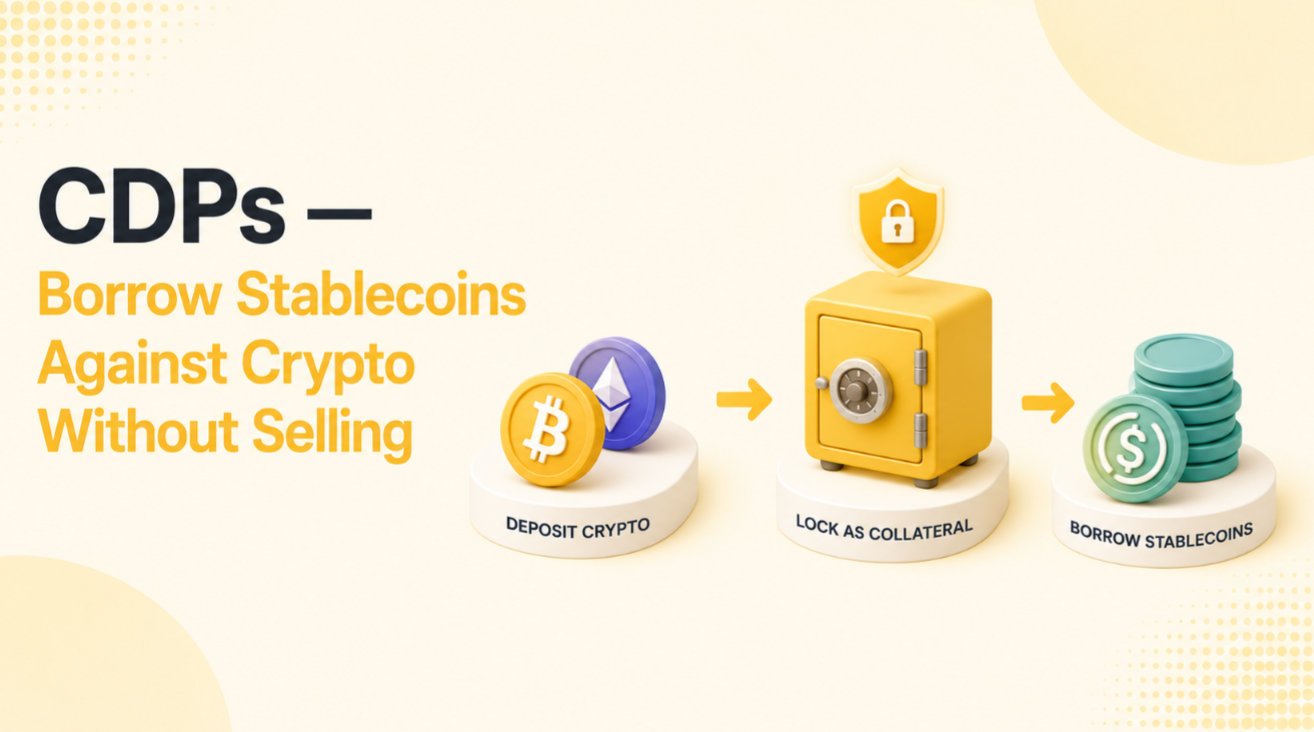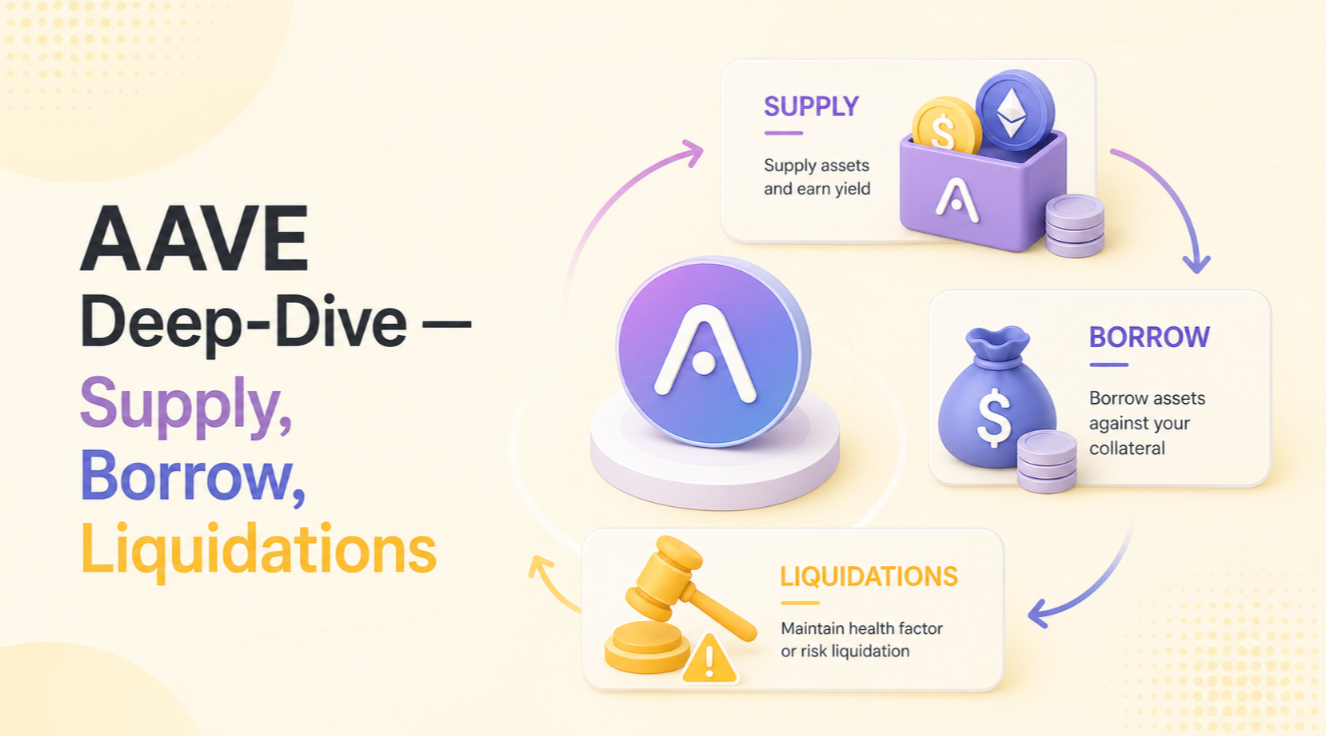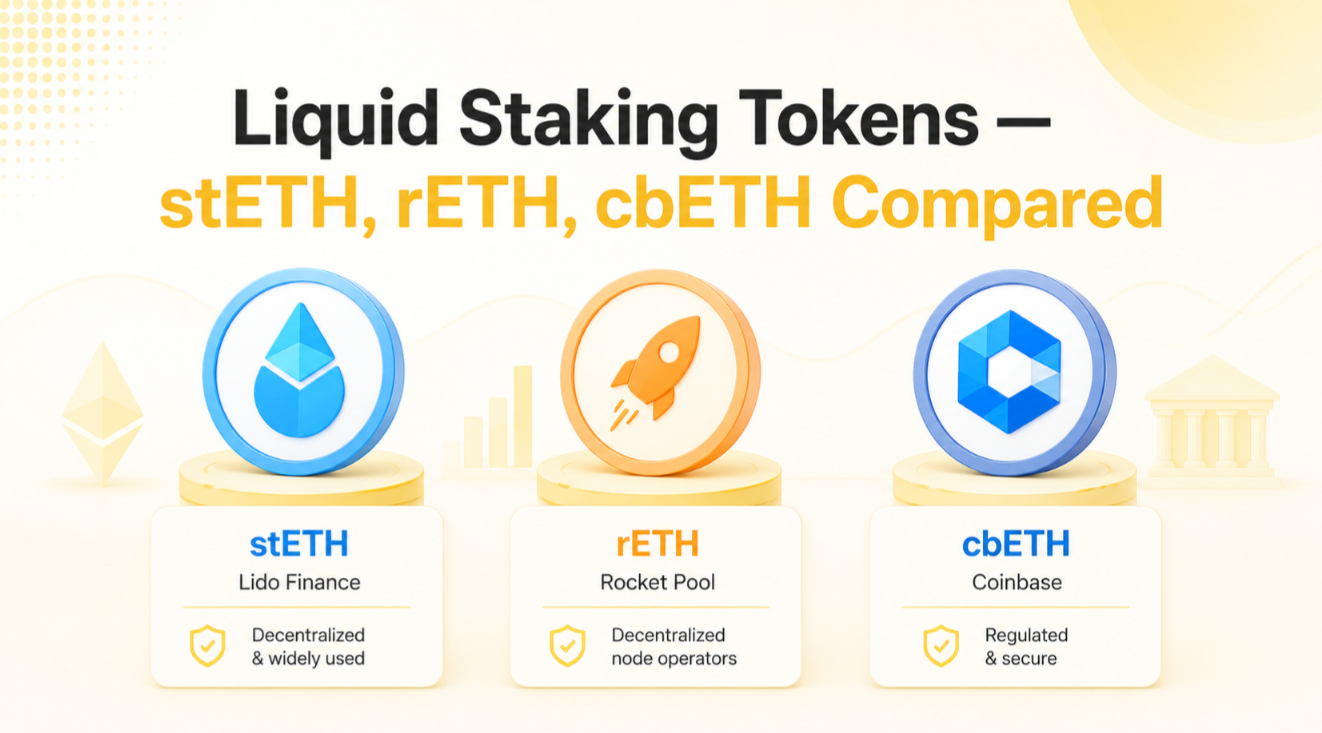
Ethereum staking earns validators around 3-5% APR by locking ETH into a validator. But locked ETH is exactly that — locked. It can't be traded, used as collateral, or moved without unstaking (which takes days). Liquid staking tokens (LSTs) solve this by wrapping staked ETH into a token you can hold and use in DeFi while still earning the underlying staking yield. Three LSTs dominate the market — stETH from Lido, rETH from Rocket Pool, and cbETH from Coinbase — each with a different design and a different set of tradeoffs.
The problem LSTs solve
To run an Ethereum validator directly, you need 32 ETH (~$100K), technical operation of a validator node, and willingness to lock the ETH for the unstaking window (currently 1-7 days depending on queue).
For most ETH holders, none of this is practical. You have less than 32 ETH, you don't want to run infrastructure, and you want your ETH usable in DeFi.
LSTs solve all three: pooled staking (any amount), operator-run infrastructure, and a tradeable token representing your staked position.
stETH (Lido) — the market leader
Issuer: Lido Finance (DAO-governed protocol).
Mechanism: Users deposit ETH into Lido. Lido pools deposits and stakes them across ~30+ node operators. Depositors receive stETH tokens representing their share of the pool. The stETH balance rebases daily to reflect staking rewards — so if you deposited 1 ETH, after some months your stETH balance might be 1.05.
Circulation: ~10M+ stETH as of 2026 (largest LST by far, ~30%+ of all staked ETH).
Where it's used: everywhere in DeFi. AAVE, Curve, Uniswap, MakerDAO all accept stETH as collateral or in pools. wstETH (wrapped stETH) is the non-rebasing version used in most DeFi contexts.
Strengths: deepest liquidity of any LST, most DeFi integration, decentralized operator set, permissionless deposits and withdrawals.
Weaknesses: Lido's outsize share (~30% of staked ETH) is a decentralization concern for Ethereum overall. If Lido misbehaves, it could threaten the network. This has been an ongoing debate in Ethereum governance.
For most users looking to stake with maximum DeFi flexibility, stETH is the default choice.
rETH (Rocket Pool) — the decentralization purist
Issuer: Rocket Pool (permissionless protocol).
Mechanism: Users deposit ETH into Rocket Pool. Node operators must post at least 8 ETH of their own plus a bond in RPL (Rocket Pool's governance token). This means operators have skin in the game — if they misbehave, they lose their bond.
The result is a smaller, more decentralized set of operators. Depositors receive rETH, which is a non-rebasing token that appreciates in value over time (rather than the balance changing).
Circulation: ~1M+ rETH as of 2026.
Where it's used: DeFi protocols that specifically want the decentralization properties of Rocket Pool. Somewhat less liquidity than stETH but still meaningful.
Strengths: more decentralized operator set (anyone can run a Rocket Pool node), operators have real skin in the game via RPL bond, non-rebasing token easier to integrate.
Weaknesses: less liquid than stETH, less DeFi integration, smaller scale means less depth for large transactions.
For users prioritizing decentralization over maximum liquidity, rETH is the choice.
cbETH (Coinbase) — the CEX-issued
Issuer: Coinbase (US-listed public company).
Mechanism: Users stake ETH through Coinbase. Coinbase issues cbETH tokens representing the staked position. Coinbase runs all the underlying validators.
Circulation: ~500K+ cbETH.
Where it's used: DeFi accepts cbETH (AAVE, Uniswap) though less than stETH. Popular with Coinbase users who want to keep their staking-related tokens in a coherent ecosystem.
Strengths: backed by Coinbase's operational quality and US regulatory compliance. Easy for Coinbase users to obtain.
Weaknesses: centralized (all validators run by Coinbase), regulatory risk (Coinbase can freeze cbETH), less decentralized than any of the alternatives.
cbETH exists mainly because Coinbase has a captive user base. For DeFi-native users, stETH or rETH are usually preferred.
Yield differences
All three LSTs earn approximately the underlying Ethereum staking yield (3-5% APR in 2026). Small differences:
- Lido takes 10% of staking rewards as protocol fee. Depositor yield ≈ 90% of underlying.
- Rocket Pool takes ~15-20% (higher because operator commission is included). Depositor yield ≈ 80-85% of underlying.
- cbETH takes 25% (Coinbase's fee). Depositor yield ≈ 75% of underlying.
The fees are the main reason yields differ. If you're staking for pure yield, stETH is the best return of the three. If you're staking for decentralization principles, rETH's lower yield is a reasonable price.
The peg and depeg risk
LSTs don't have a hard peg to ETH. Their market price relative to ETH fluctuates based on:
- Supply/demand for the LST in DEX pools
- Perceived credit risk of the issuer
- Confidence in the unstaking mechanism
- General DeFi conditions
Historical depeg events:
- May 2022 (Luna crash contagion): stETH dropped to 0.94 ETH as investors rushed to exit. Recovered to peg within weeks after unstaking became possible.
- June 2022 (3AC, Celsius stress): stETH stayed below peg (~0.95-0.97) for weeks as forced sellers dumped positions.
- Various minor deviations of 0.5-2% during normal market conditions.
Post-Shanghai upgrade (April 2023), Ethereum enabled withdrawals, so unstaking is much faster than in 2022. This has largely eliminated large depeg risk — LST prices track ETH within ~0.5% consistently now.
But depeg risk isn't zero. If a LST issuer had a major incident (Lido governance dispute, Rocket Pool operator mass slashing, Coinbase legal issues), the market could revalue the LST significantly downward.
DeFi usage patterns
LSTs are heavily integrated in DeFi:
- **Collateral for borrowing**: AAVE and Compound accept stETH, wstETH, rETH as collateral. Users borrow stablecoins against staked ETH.
- **DEX pools**: Curve's ETH/stETH pool is one of the largest DEX pools in DeFi. Uniswap V3 has deep wstETH pools.
- **Yield strategies**: various protocols offer "leveraged stETH" strategies (borrow ETH against stETH, restake, etc.).
- **CDPs**: MakerDAO accepts wstETH as collateral for DAI generation.
For a user who wants both staking yield and DeFi participation, LST-based strategies are the standard playbook.
The centralization concern
Ethereum's core value proposition includes decentralized validation. If a single entity controls 30%+ of staked ETH (as Lido does), it has significant power — over MEV extraction, over censorship, over network upgrades in some scenarios.
Ethereum governance has debated whether to introduce mechanisms that would penalize excessive concentration. Lido has voluntarily committed to keeping their share below certain thresholds. But the tension remains: users prefer stETH for liquidity, which increases Lido's share, which increases centralization concern.
For principled decentralization, using a mix of LSTs (stETH, rETH, plus maybe self-staking if you can) is the responsible approach. Using only Lido concentrates the ecosystem risk.
Emerging LSTs
Beyond the big three:
- **swETH (Swell)**: mid-tier, decentralization-focused
- **osETH (StakeWise)**: mid-tier
- **ETHx (Stader)**: growing but small
- **frxETH (Frax)**: interesting design that also earns from Frax's stablecoin activity
None threatens the big three's dominance in the near term, but the LST market continues to diversify.
For a user
Practical guidance:
- If maximum liquidity and DeFi flexibility matter: stETH (specifically wstETH for DeFi contexts).
- If decentralization principles matter more: rETH.
- If you're already deep in Coinbase's ecosystem: cbETH is convenient.
- For diversification: hold a mix, especially if your staked ETH exceeds a certain threshold.
Never assume LSTs are risk-free — they carry smart-contract risk (Lido's or Rocket Pool's code), operator risk (validator slashing), and depeg risk (in stressed markets). Underlying ETH exposure is still the primary risk factor, but LST-specific risks add a layer on top.