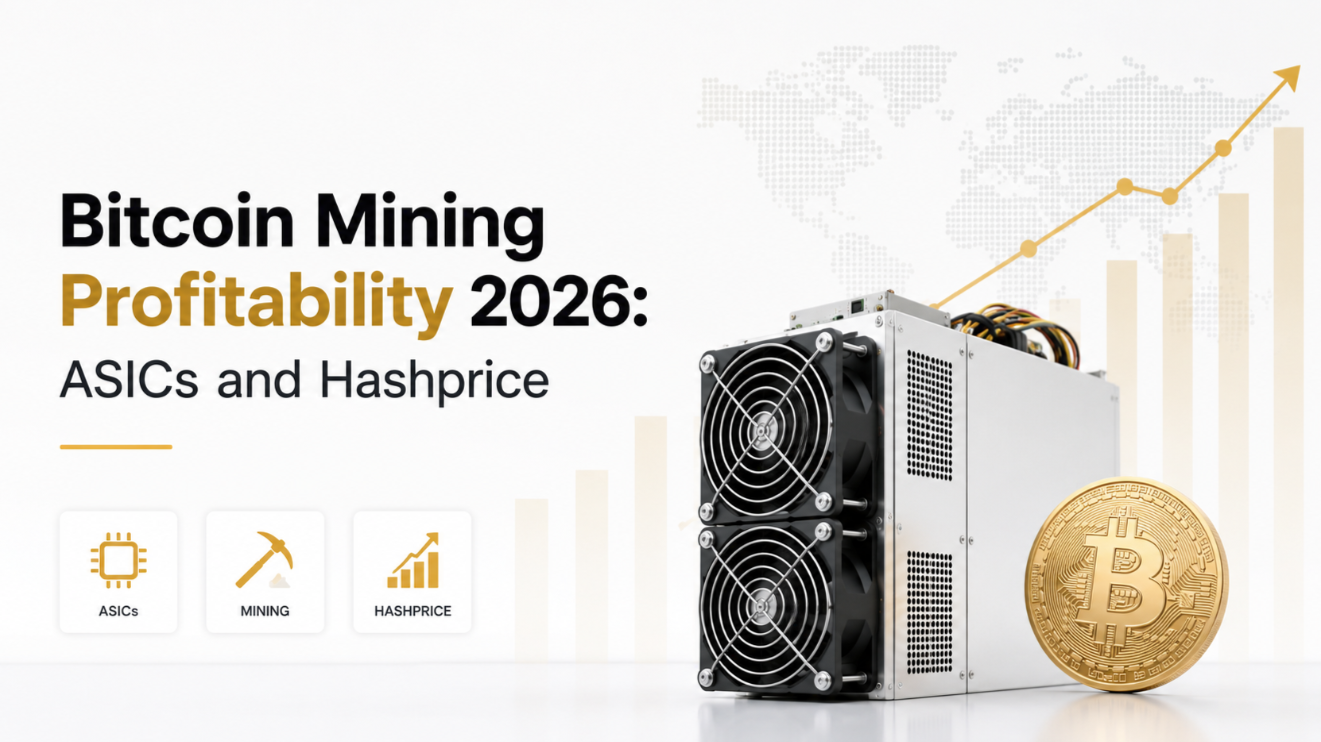
Bitcoin mining in 2026 is post-halving (April 2024 brought the block reward to 3.125 BTC). Network hashrate hovers around 800 EH/s. Hashprice — daily revenue per TH/s — is the variable that determines whether your ASIC pays for itself.
The 2026 ASIC field
- Bitmain Antminer S21+ Hyd — 350 TH/s at 15.5 J/TH. ~$5,500 retail.
- Bitmain Antminer S21 Pro — 234 TH/s at 15 J/TH. ~$4,200 retail.
- MicroBT Whatsminer M60 Series — 200–280 TH/s, 16–18 J/TH. $3,500–4,800.
- Canaan Avalon A1566 — 185 TH/s at 18.5 J/TH. ~$3,200 retail.
Hashprice math in 2026
A hashprice of $55/PH/s/day means an S21 Pro (234 TH/s) generates about $13/day in revenue at current rates. Subtract electricity (3,460W × 24h × your $/kWh) and you have daily margin. At $0.05/kWh, daily power is $4.15, so net is ~$9. Payback in roughly 470 days under stable conditions.
Electricity thresholds
- $0.03/kWh — Profitable for almost any modern ASIC.
- $0.05/kWh — Profitable for S21+ and S21 Pro; marginal for older S19j Pro.
- $0.07/kWh — Only top-efficiency machines (S21+ Hyd) break even at typical hashprice.
- $0.10/kWh — Generally unprofitable; only worth it for heat-recovery applications.
Hosted mining vs self-hosted
Public-miner hosting in cheap-power states (Texas, Washington, Paraguay) costs $0.06–0.08/kWh all-in, including hardware management. Self-hosting at home with $0.05/kWh wholesale rates can beat hosting on margin, at the cost of noise, heat, and operational complexity.
Risk factors
- Difficulty adjustments — Network hashrate growth reduces per-machine yield.
- Bitcoin price — A 30% BTC drawdown shrinks revenue 30%, often pushing marginal miners offline.
- Electricity cost surprises — Time-of-use, demand charges, and grid curtailment can erase modelled profit.
- Hardware lifespan — Modern ASICs last 3–5 years; older models are usually retired before full payback.
See our Bitcoin mining pools comparison and home Bitcoin mining setup guide.