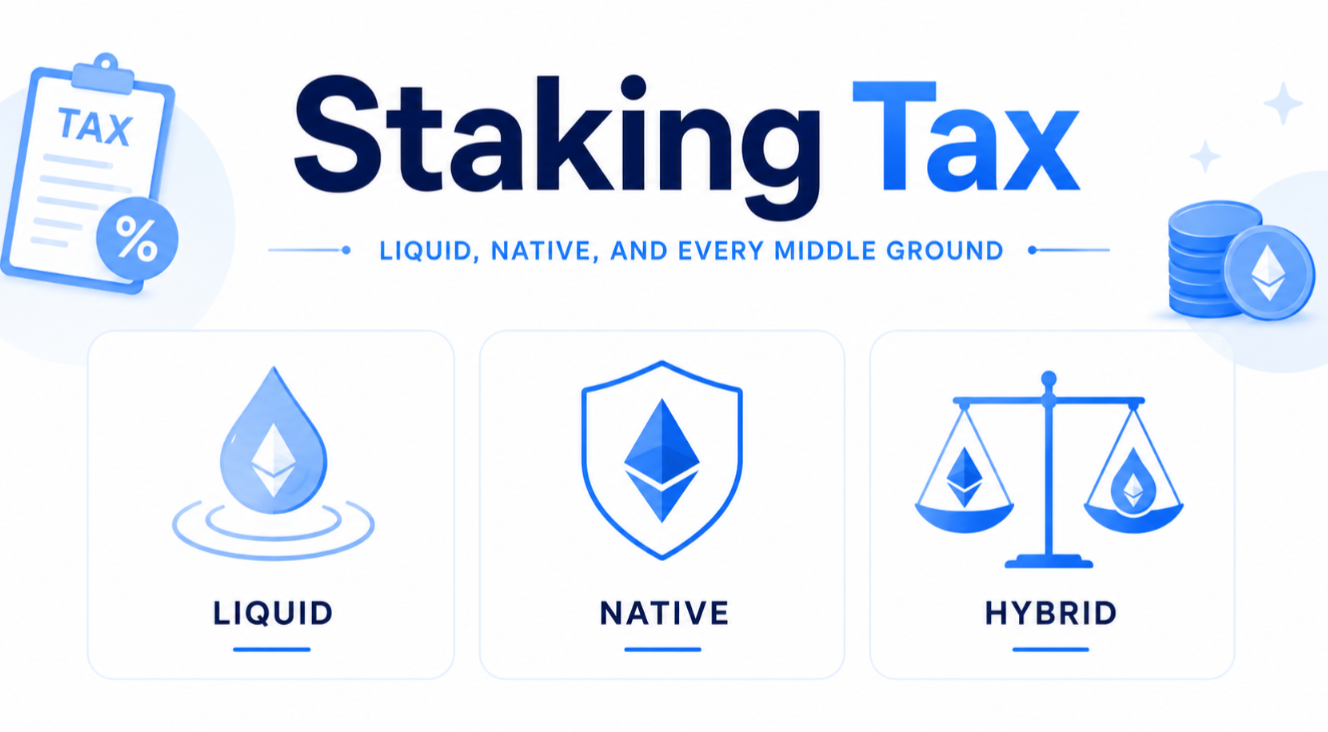
Staking has become one of the largest ways crypto users earn yield. Ethereum staking alone locks up millions of ETH earning ~3-5% APR. But staking creates significant tax obligations that vary substantially by staking type — native, liquid, or restaking. Understanding the tax mechanics of each is important both for accurate reporting and for choosing the right staking method for your situation.
**Not tax advice. Consult a professional for your jurisdiction and circumstances.**
The core question
For any staking arrangement, the key tax questions are:
1. When are rewards recognized as income? 2. At what value? 3. What's the cost basis of received tokens? 4. What happens on later sale?
Different staking types answer these differently.
Native Ethereum staking
Native staking: you (or your service) run an Ethereum validator with 32 ETH per validator. Rewards accrue to the validator's balance.
**When rewards are recognized**: this is contested. Positions include:
- **Continuous accrual view**: rewards accrue block by block and should be recognized as they accrue.
- **Sweep-based view**: rewards are recognized when they're actually swept to your address (withdrawals happen periodically).
- **Withdrawal view**: rewards are recognized only when you actually withdraw and receive them in your address.
The IRS 2023 guidance (Revenue Ruling 2023-14) suggested that staking rewards are income at receipt when the user has "dominion and control" — arguably meaning when they're sweepable. But there's ambiguity, and the guidance was for the older PoW-like reward mechanism.
Most tax software uses "sweep-based" or "withdrawal-based" recognition.
**Cost basis**: the fair market value at recognition time becomes your basis for those tokens.
**Later sale**: gain/loss vs the cost basis. Holding period starts at recognition.
Solo validator complications
If you run your own validator:
- Slashing losses (validator penalties) can theoretically be deductible losses, but treatment is unclear.
- Priority fees earned by proposing blocks are income at recognition.
- MEV boost payments are income at recognition.
Solo validators need to track each source separately. This is significantly more complex than simple LST holding.
Liquid staking (LSTs)
LSTs like stETH, rETH, cbETH represent staked ETH but are freely tradeable.
**Two types of LST reward mechanisms**:
1. **Rebasing** (stETH): the balance in your wallet increases as rewards accrue. If you had 1 stETH, after months you might have 1.05 stETH. 2. **Value-accruing** (rETH, cbETH, wstETH): balance stays the same but each token becomes worth more ETH over time.
**Rebasing token taxation**: each rebase might be considered a taxable event with the increased balance as income. This creates many small taxable events over time (daily rebases). Tax software approximates by using daily or weekly aggregation.
**Value-accruing token taxation**: the appreciation is arguably not income until sale. When you sell rETH for ETH, you have a capital gain based on the exchange rate difference.
Value-accruing tokens are simpler for tax purposes — one event on sale rather than many events on rebase. This is one reason wstETH (wrapped, non-rebasing stETH) is preferred over raw stETH for holding.
**Cost basis of LSTs**: the price you paid when acquiring the LST (in USD terms) is your basis. If you deposited ETH directly to Lido to receive stETH, cost basis equals what the ETH was worth at deposit.
Restaking (EigenLayer, LRTs)
Restaking generates multiple income streams:
- Base ETH staking yield (via the underlying LST)
- AVS rewards (potentially in various tokens)
- Points (which may later convert to tokens or airdrops)
Each is potentially a taxable event with different timing and treatment.
**LRT tokens**: liquid restaking tokens like eETH, rsETH. Similar to LSTs but wrapping restaked positions. Same rebasing vs value-accruing distinction applies.
**AVS token rewards**: typically ordinary income at fair market value when received. If you receive 100 EIGEN tokens worth $0.50 each, that's $50 of income at receipt.
**Points that later convert to tokens**: uncertain territory. Some interpretations: income when points are received (though they're not really tokens). Other interpretations: income only when converted to actual tokens. Most tax positions currently: income at token receipt.
Restaking generates enough tax complexity that professional consultation is often warranted.
Custodial staking (Coinbase, Binance, etc.)
Staking through a CEX where the exchange handles validator operations:
- Rewards are typically reported by the exchange to tax authorities (US: Form 1099-MISC for services like Coinbase).
- Simpler for you as a user — the exchange handles recognition timing.
- Same fundamental tax treatment: rewards are ordinary income at recognition; cost basis for future sale.
CEX staking is generally simpler for tax purposes than LST or restaking, though it introduces CEX counterparty risk.
The rewards-as-income vs rewards-as-property debate
There's an unresolved legal question: are staking rewards "income" (immediately taxable) or "property created" (not taxable until sale)?
The Jarrett case (a 2022 US court case involving Tezos staking) initially seemed to favor the property view — the court refunded taxes on rewards, but the ruling was based on procedural grounds and doesn't create binding precedent.
The IRS's 2023 revenue ruling took the income position. Most practitioners follow this.
If the property view eventually prevails, staking becomes much more tax-favorable. For now, assume rewards are taxable income.
International variance
Different countries treat staking rewards differently:
- **US**: ordinary income at receipt (per IRS 2023 guidance).
- **UK**: income tax on rewards; capital gains on later sale.
- **Germany**: staking rewards potentially tax-free after 10 years of holding (special "staking hold" rules).
- **Switzerland**: capital gains often tax-free for private investors; staking rewards may be subject to income tax.
- **Singapore**: generally no capital gains tax; staking may be considered service income.
For tax residents of any country, learn that country's specific rules. US-centric guidance doesn't translate.
The reporting problem
For serious stakers:
- Every reward event needs a value at time of receipt.
- Historical prices of tokens like CRV, EIGEN, etc. need to be pulled from oracles or manual sources.
- Multiple wallets and protocols need to be aggregated.
- Rebasing tokens create hundreds of events per year.
Tax software handles most of this automatically. But manual review of complex staking arrangements is often necessary.
Practical guidance
**Simple approach — CEX staking**:
- Use Coinbase, Binance, or Kraken for staking.
- They report to tax authorities in most jurisdictions.
- Tax reporting is largely handled.
- Downside: CEX counterparty risk.
**Intermediate approach — LST holding**:
- Use wstETH or rETH (non-rebasing).
- Simpler tax treatment than rebasing tokens.
- Use crypto tax software to handle sale calculations.
**Advanced approach — restaking**:
- Requires careful tracking of multiple reward streams.
- Almost certainly needs professional tax help.
- Consider whether the extra yield justifies the tax complexity.
For anyone considering staking
Before starting a staking strategy:
1. Understand your jurisdiction's tax treatment. 2. Choose a staking type whose tax complexity you can manage. 3. Set up crypto tax software from day one. 4. Track cost basis at time of every reward event. 5. Consult a professional for anything complex.
The tax cost of staking can be significant. Adding 20% to your gross yield calculation for tax overhead is often reasonable. Actual after-tax return on 4% APR staking might be 2.5-3% for a high-income US taxpayer.
The takeaway
Staking tax is more complex than most casual stakers realize. Native > LST > restaking in order of complexity, but even the "simple" cases have edge cases.
For most retail stakers, using non-rebasing LSTs with proper tax software is the pragmatic middle ground. For high-value stakers or restakers, professional help is essentially required.
The value of understanding this: informed choices about which staking type fits your tax situation. Someone in a high-tax jurisdiction might prefer capital-gains-favored strategies over income-heavy ones. Someone in a low-tax jurisdiction has more freedom to optimize for yield.
**Reminder: not tax advice. Consult a qualified professional.**