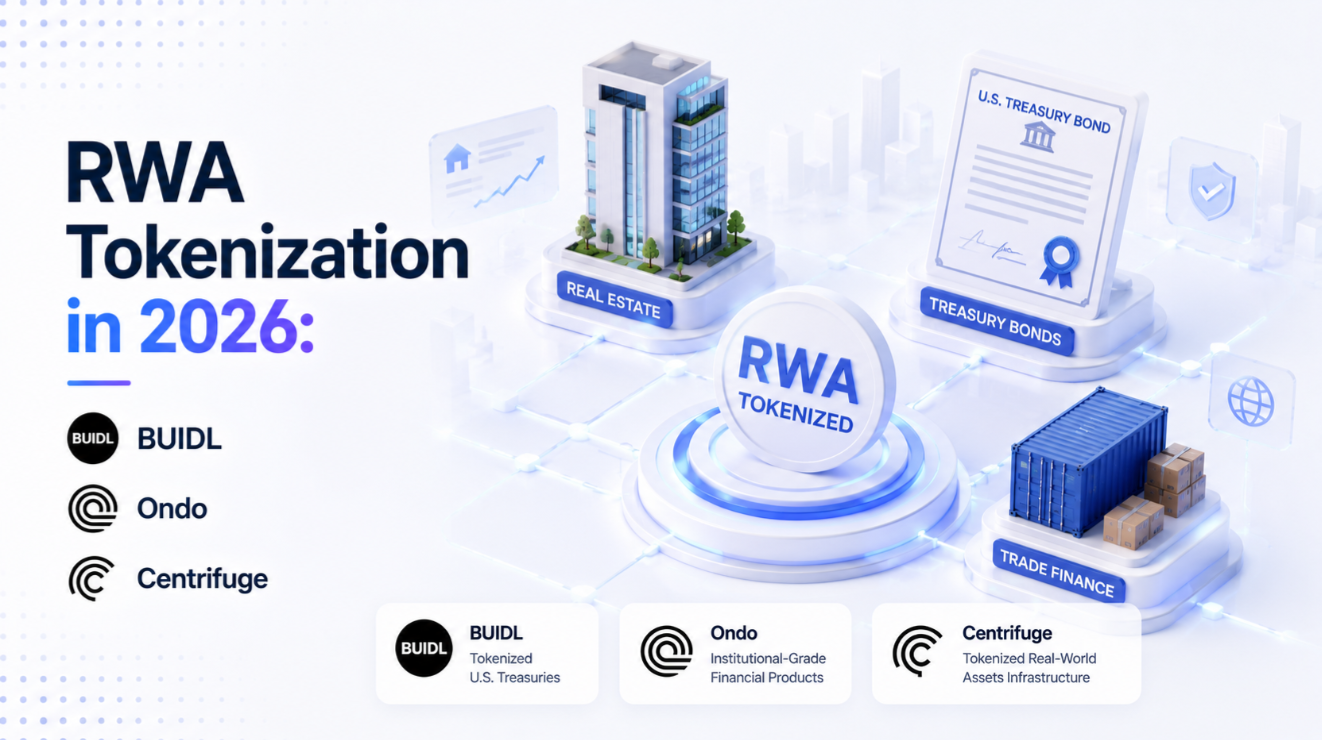
RWA crossed $50B on-chain in 2026, with BlackRock's BUIDL alone holding over $10B. The story is no longer hypothetical — it is the second-largest yield bucket in crypto after stablecoins.
The four RWA categories that matter
- Tokenized Treasuries — BUIDL (BlackRock), BENJI (Franklin Templeton), USDY (Ondo), USYC (Hashnote). ~$30B combined.
- Private credit — Centrifuge, Maple Finance, Goldfinch. ~$8B in active loans.
- Real estate — RealT, Lofty, Backed. Smaller, more retail-focused.
- Equities and ETFs — Backed Finance, Dinari, Securitize. Re-emerged after the 2023 false starts.
BlackRock BUIDL: the institutional anchor
BUIDL holds short-term US Treasuries and yields ~4.7% to qualified investors. Available on Ethereum, Aptos, Avalanche, Arbitrum, Optimism, and Polygon. Composability inside DeFi — Pendle, Aave, Frax — makes it the building block of dollar-denominated yield strategies.
Ondo Finance: retail-accessible Treasury exposure
USDY is Ondo's permissionless tokenized Treasury offering, accessible to non-US investors. OUSG is the institutional-grade product. Both pay 4–5% yield, redeemable for stablecoins. Ondo also runs the rapidly growing Ondo Chain for compliant RWA settlement.
Centrifuge: on-chain private credit
Centrifuge tokenizes real-world loans — invoice financing, real-estate-backed credit, trade finance — and offers them as on-chain investments. Yields are higher (8–14%) but credit risk is the trade-off. MakerDAO uses Centrifuge heavily to back DAI with real-world assets.
Real estate and equities
Real-estate tokenization (Lofty, RealT) gives retail fractional exposure to rental properties, with yields of 6–10%. Tokenized equities (Backed, Dinari) give 24/7 access to large-cap stocks. Adoption is real but the regulatory perimeter still limits US participation.
Where the yield comes from
Most RWA yield in 2026 is simple — short-term Treasuries. The "DeFi premium" comes from composability (collateralize BUIDL on Pendle for fixed yield) and from accessing markets retail users could not otherwise reach (private credit). Risk-adjusted, RWA is the most defensible yield in the ecosystem.
Risks to track
- Issuer credit risk — these are still claims against an issuer.
- Regulatory risk — securities laws vary by jurisdiction; US Persons are excluded from many products.
- Smart contract risk — the wrapper around the asset can fail even when the asset is sound.
- Liquidity risk — secondary markets for RWA tokens are still thin.
See our yield-bearing stablecoins guide and tokenized Treasuries deep-dive.