Yield-bearing stablecoins (YBS) emerged as the next-generation stablecoin in 2024–2025. Holding one earns yield natively, without lending it out. By 2026, the category is meaningful but the underlying yield sources — and risks — differ sharply between products.
Ethena USDe / sUSDe
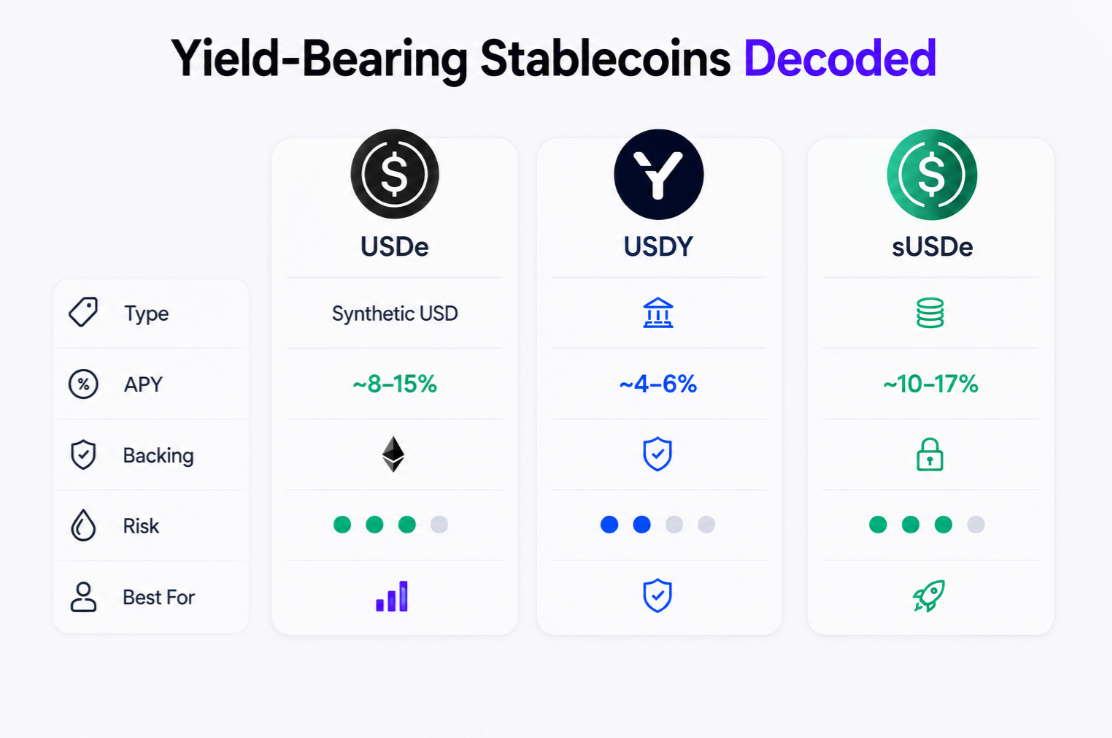
USDe is a synthetic dollar backed by ETH plus a short ETH perpetual position (delta-neutral). Yield comes from perpetual funding rates plus ETH staking. sUSDe is the staked version that accrues yield. In 2026, sUSDe yields range from 6% to 14% depending on funding conditions. Risk: funding rates can go negative; ETH price stress can expose the hedge.
Ondo USDY
Backed by short-term US Treasuries (~4.7% yield). Permissionless globally except US Persons. Composable across DeFi (Pendle, Aave, Morpho). The simplest "real yield" structure available — straightforward Treasury exposure on-chain.
Maker sDAI
Wrapped version of DAI deposited into Maker's DSR. Yield (~4.5%) comes from Maker's allocation to short-term Treasury bills via the protocol's RWA modules. Backed by the Maker protocol's collateral. The closest thing to a "DeFi-native risk-free rate."
Frax sFRAX
Frax's yield-bearing version, backed by a mix of Treasuries (via Frax's RWA partners) and DeFi-native sources. Yields track US T-Bill rates closely. Smaller TVL than sDAI but solid execution.
How yields actually break down
- Treasury-backed (USDY, sDAI, sFRAX) — 4–5% from real T-Bill yields. Stable. Tax-treated as interest in most jurisdictions.
- Delta-neutral (USDe, sUSDe) — 6–14% from funding + staking. Volatile. Higher tail risk during ETH stress.
- LP / strategy-based (various smaller products) — Variable; depend on specific DeFi strategy success.
Risks specific to YBS
- Sustained negative funding (USDe) — Can wipe yield and require principal absorption.
- Custodian or issuer risk (USDY, sFRAX) — Real Treasuries held by traditional custodians; failure modes resemble money market funds.
- Smart contract risk — Each protocol's contracts. sDAI through Spark, USDe through Ethena, etc.
- Regulatory risk — YBS may be treated as securities in some jurisdictions, restricting access.
Where YBS fit in a portfolio
For stablecoin holdings where you want native yield without lending: USDY or sDAI for conservative exposure; sUSDe for higher yield with understanding of the basis-trade risk. Diversifying across two YBS sources lowers single-product failure risk.
See our stablecoin risk guide and stablecoin yields comparison.