Stablecoin yields are the lowest-risk, most-composable bucket in crypto. In 2026, four sources cover almost everything a sensible portfolio needs.
1. Aave: the workhorse lending pool
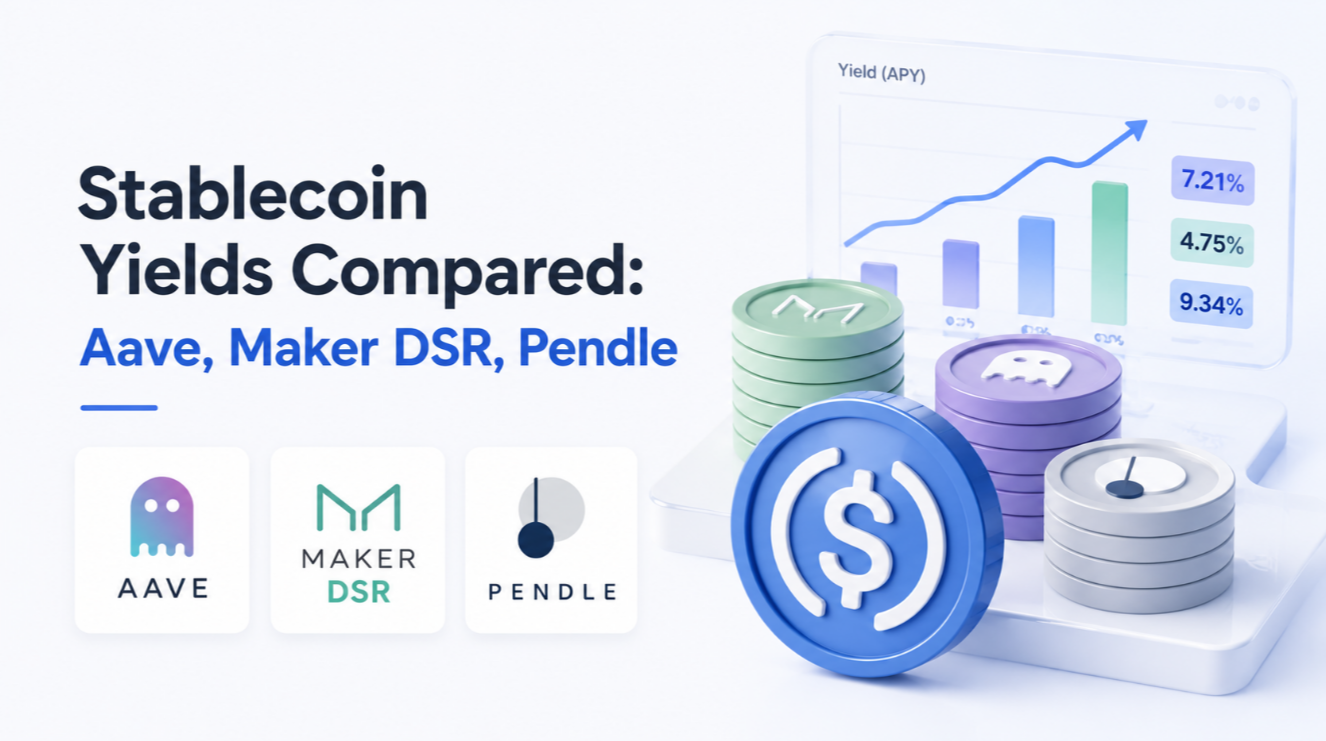
USDC, USDT, GHO, and DAI on Aave currently pay 3–7% supply APY depending on utilisation. Smart-contract risk is low (Aave has processed $1T+ over multiple years). Withdraw anytime. Best for the bulk of stablecoin holdings.
2. Maker DSR (sDAI): the protocol-native risk-free rate
Deposit DAI into the Dai Savings Rate via Spark or directly. You get sDAI, which accrues yield (~4.5% in 2026) backed by the Maker protocol's Treasury allocations. Conservative, transparent, and a key DeFi building block.
3. Pendle: fixed-rate yield through 2026
Pendle splits yield-bearing assets into Principal Tokens (PT) and Yield Tokens (YT). Lock in 5–7% fixed yield on stablecoin LP positions, ETH staking yield, or BUIDL by buying PT and holding to maturity. Sophisticated but rewards careful users.
4. Ondo USDY: tokenized Treasury yield
USDY pays ~4.7% from short-term US Treasuries. Non-US permissionless, US-restricted. Composable in DeFi (collateral on Pendle, Aave, Morpho). The simplest "real yield" available to crypto-native users.
A sensible 2026 stablecoin portfolio
- 50% Aave USDC supply — Maximum flexibility and yield.
- 25% sDAI — Diversification from USDC; protocol-native yield.
- 15% Pendle PT (fixed rate) — Lock in yield through a horizon.
- 10% USDY — Real Treasury exposure for safety.
Yields to avoid
CEX promotional rates ("10% APY on USDT, locked 90 days") almost always carry hidden counterparty risk — Celsius, BlockFi, and Voyager all paid headline rates before failing. New "high-yield" stablecoin protocols with no audit history are usually exits in disguise. If a yield is more than 2× the lending market rate, ask hard questions.
Tax efficiency
Most stablecoin yield (Aave interest, DSR, USDY distributions) is ordinary income in most jurisdictions. Pendle PT yield is realised as capital gain only on disposal — for the right user, this can be meaningfully more tax-efficient.
See our yield-bearing stablecoins guide and the DeFi lending guide.