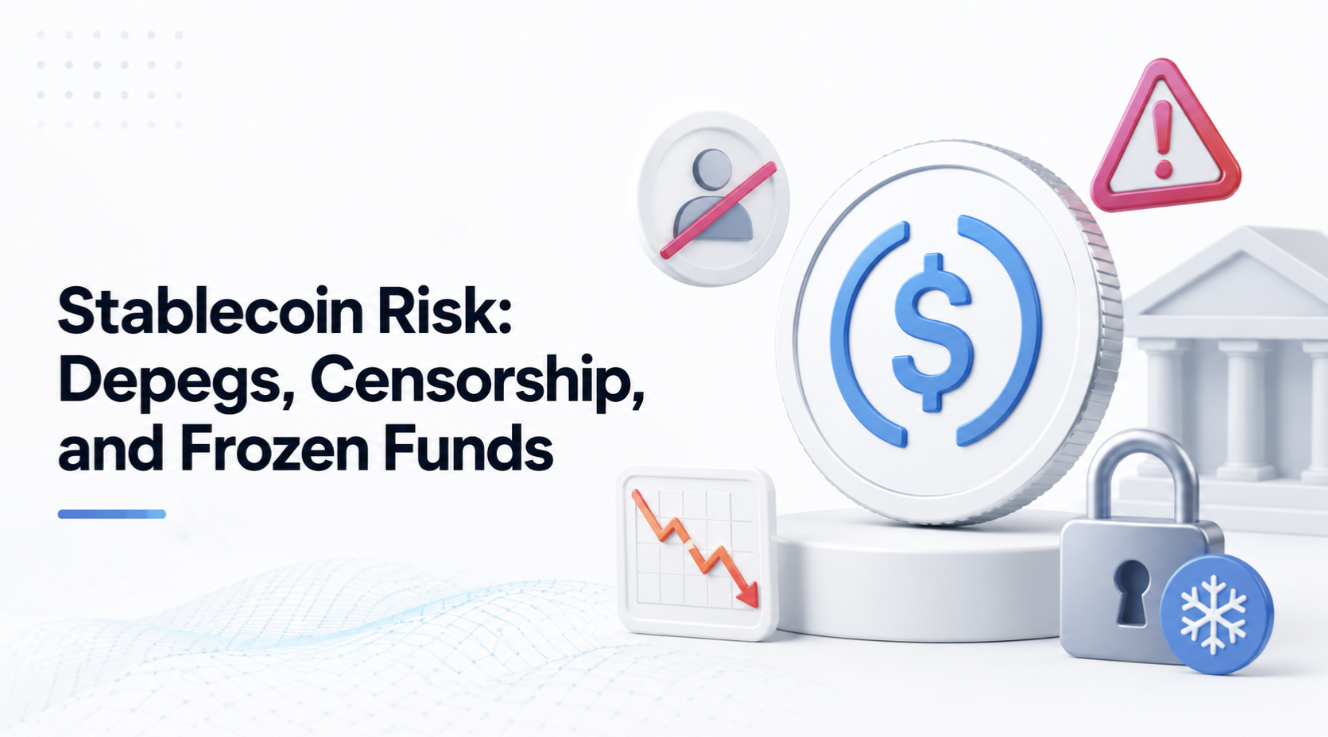
Stablecoins move trillions per year and underpin most of DeFi. They also have real, well-documented failure modes. Treating them as "the same as dollars" is the most common stablecoin mistake.
Failure mode 1: Depegs
Terra UST (May 2022) collapsed entirely — algorithmic stablecoin with no real collateral. USDC (March 2023) briefly dipped to $0.87 when Silicon Valley Bank held $3.3B of Circle's reserves; recovered within 72 hours after FDIC backstop. DAI depegs typically follow USDC because DAI holds USDC as collateral. Tether has held its peg through repeated stress events, though its reserves have drawn ongoing scrutiny.
Failure mode 2: Issuer freezes and blacklists
Tether and Circle (USDC) can freeze any address on legal demand. Both have done so for sanctioned addresses, hacks (Ronin, Wormhole, Curve exploiter), and OFAC-listed entities. This is a feature in some contexts (returning stolen funds), a vulnerability in others (you can be cut off from your "dollars" by an issuer compliance team).
Failure mode 3: Regulatory disqualification
Post-MiCA, USDT is delisted from EU-regulated exchanges because Tether did not pursue MiCA compliance in time. Holders in the EU can still use USDT through non-licensed venues, but liquidity has migrated to USDC and EUR-pegged alternatives. Similar regulatory shifts can disqualify any stablecoin from specific markets overnight.
Failure mode 4: Reserve composition shock
A stablecoin's reserves matter more than its peg. USDT historically held commercial paper (riskier) before shifting to mostly Treasuries. A surprise downgrade or default in reserve assets could trigger a redemption run before the issuer can liquidate.
How to manage stablecoin risk
- Diversify across two or more issuers — Hold both USDC and USDT for transactional needs.
- Use over-collateralised stablecoins — DAI, GHO, sFRAX have transparent on-chain collateral.
- Limit on-CEX stablecoin balances — CEX failures are how most stablecoin holders lose money.
- Bridge cautiously — Native stablecoins on each chain are safer than bridge-wrapped versions.
- Watch peg in real time — Even a 0.5% depeg signals stress; consider exiting before deeper events.
When to prefer self-custody over yield
In high-uncertainty periods (banking stress, regulatory enforcement waves), the optionality of having your stablecoins in a personal wallet — not on a yield protocol or CEX — can be worth more than the yield itself. Most yield strategies have implicit lockup or withdrawal queues that bite during stress.
See our Tether vs USDC vs DAI comparison and our stablecoin yields guide.