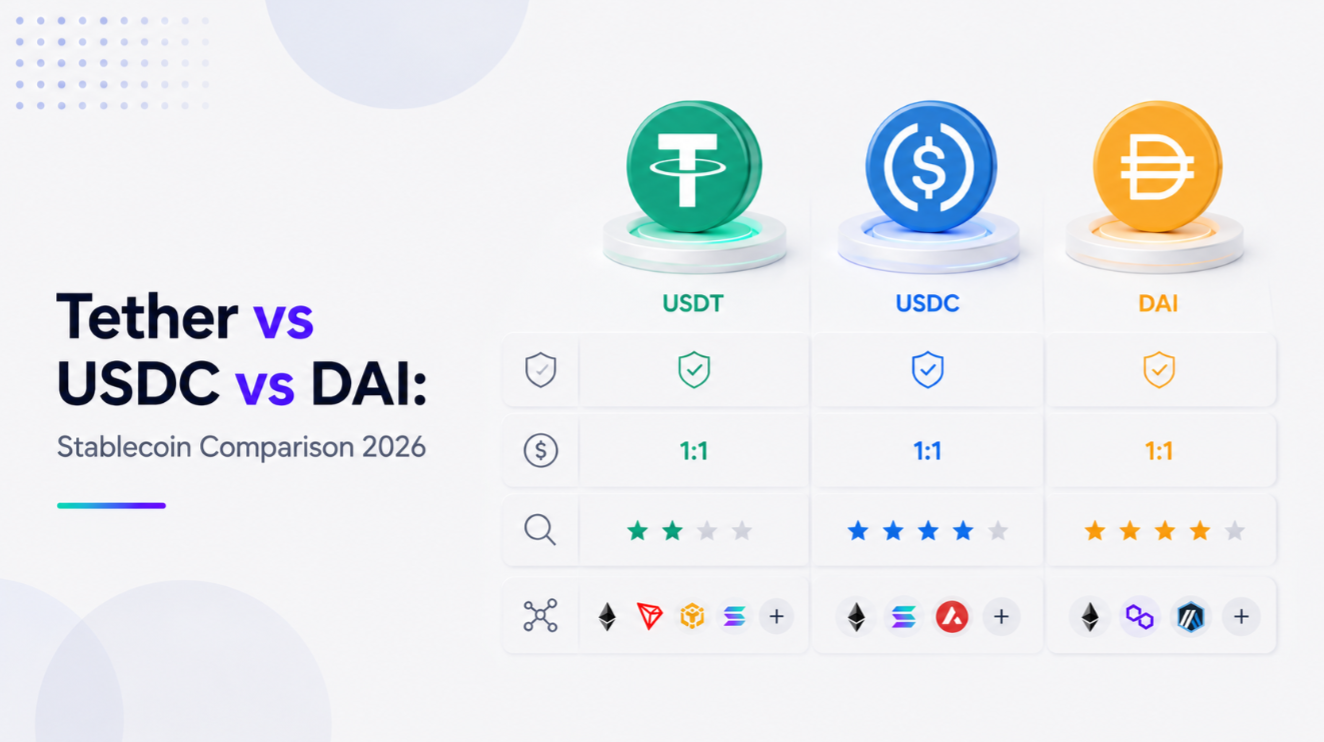
Tether (USDT), Circle (USDC), and Maker DAO (DAI) account for the vast majority of stablecoin volume in 2026. Each has a different model, a different regulatory posture, and a different risk profile. Here is the honest side-by-side.
Tether (USDT)
Market cap: ~$135B in 2026, the largest by a comfortable margin. Issued by Tether Limited, with reserves dominated by US Treasuries (~$95B). Strong in emerging markets, especially the Tron-based USDT used for remittances. EU exchanges have delisted USDT under MiCA. US regulatory exposure remains.
USDC
Market cap: ~$45B. Issued by Circle, fully backed by Treasuries and cash held with regulated US banks. Most regulator-compliant — first stablecoin to publish monthly attestations, MiCA-compliant in the EU, audited by Deloitte. Deeply integrated with US-based exchanges and DeFi protocols.
DAI
Market cap: ~$5B. Issued by the Maker protocol via over-collateralisation (ETH, stETH, USDC, RWA). Decentralised governance; no single issuer. Collateral mix has shifted toward Treasuries via RWA partners, reducing — but not eliminating — USDC dependence.
Side-by-side
- Size / liquidity — USDT >> USDC > DAI.
- Regulatory clarity — USDC > DAI > USDT.
- Decentralisation — DAI >> USDC ≈ USDT.
- Blacklist risk — Highest USDT/USDC (issuer can freeze). Lowest DAI (governance-driven and slow).
- Yield ecosystem — All three are accepted across major lending protocols.
Which to pick when
- Holding dollars long-term safely — Diversify across USDC and DAI; USDT if regulatory risk is acceptable.
- Trading on global CEXs — USDT remains the deepest market.
- EU residents on regulated exchanges — USDC by default; USDT delisted.
- DeFi power user — DAI for the decentralised story; USDC for liquidity; USDT for cross-chain reach.
- Emerging markets / remittances — USDT (Tron) is the practical default.
What about USDS (formerly DAI)?
Sky (the rebrand of MakerDAO's ecosystem) launched USDS in 2024 as a multi-chain successor to DAI. USDS and DAI are interchangeable. Sky is gradually deprecating DAI branding, though the original DAI continues to function alongside.
See our stablecoin risk guide and the yield-bearing stablecoins deep-dive.