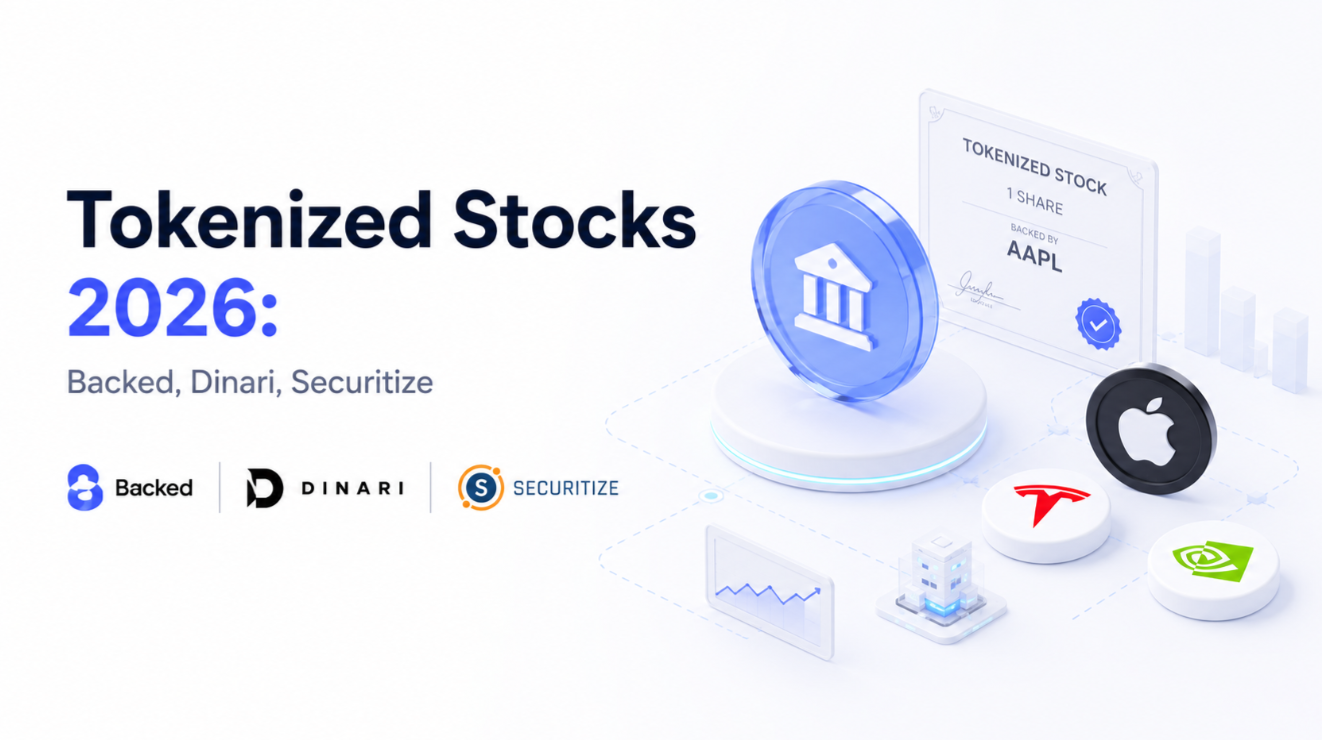
Tokenized equities tried and failed in 2021 (Mirror Protocol, FTX's tokenized stocks). The 2024–2026 generation took a different approach — actual share-backed tokens issued through licensed entities — and the result is finally functional, if not yet mainstream.
How modern tokenized stocks work
A licensed broker-dealer (Backed Finance, Dinari, or others) buys actual shares and holds them in custody. They mint tokens 1:1 representing those shares. Token holders can redeem 1:1 for the underlying equity (where permitted by jurisdiction). Dividends pass through to token holders.
The leading platforms in 2026
- Backed Finance — Swiss-regulated, issues bC3M (3-month Treasury ETF), bIB01 (1-3 year Treasury ETF), bCSPX (S&P 500 ETF), and dozens of major equities.
- Dinari — US-licensed broker-dealer, issues dShares (Apple, Tesla, Nvidia, Coinbase). Restricted to non-US persons.
- Securitize — Tokenisation infrastructure used by multiple equity issuances.
- Coinbase International — Tokenised stock futures available in non-US markets.
Why tokenize stocks
- 24/7 trading — Equity markets close; tokenised versions trade always.
- On-chain composability — Use as DeFi collateral, integrate into yield strategies.
- Global access — Non-US investors who cannot easily access US markets through traditional brokers.
- Settlement speed — Atomic on-chain settlement instead of T+2.
Regulatory perimeter
US Persons are blocked from most tokenized stock platforms — securities laws apply, and most platforms operate offshore precisely to avoid SEC jurisdiction. EU and Asia have clearer paths under existing frameworks. The 2025 FIT21 Act partially clarified the US framework; full US retail access remains pending.
Risks specific to tokenized stocks
- Issuer credit risk — You hold a token; the issuer holds the actual stock. Failure of the issuer is a real failure mode.
- Liquidity — Secondary markets are still thinner than primary exchanges.
- Tracking error — Token prices can deviate from underlying stock during off-hours.
- Regulatory shifts — Access can be revoked in your jurisdiction at any time.
See our RWA tokenization guide.