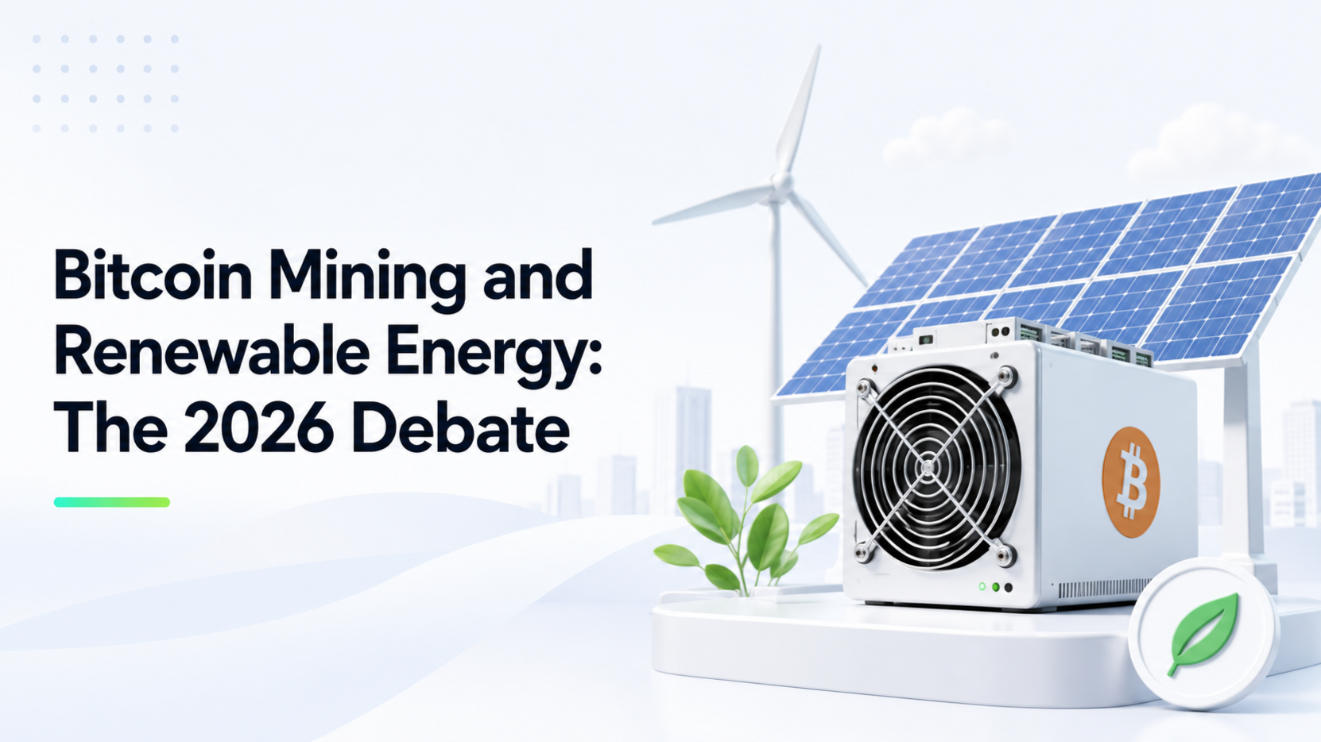
Bitcoin mining's energy footprint has been a persistent political pressure point. The 2026 picture is messier than the 2021 talking points — meaningful renewable adoption, real grid-balancing utility, and continued enforcement risk in several jurisdictions.
The renewable share in 2026
Industry surveys (Cambridge CCAF, Bitcoin Mining Council) put the renewable + sustainable share at around 55–60% in 2026 — up from ~40% in 2021. Hydroelectric in Paraguay and Bhutan, wind and natural-gas-flaring in Texas, solar at Latin American sites. The shift was driven less by virtue than by economics: renewables are now the cheapest dispatchable power.
Stranded energy and grid balancing
Modern grid operators — ERCOT (Texas) most prominently — pay miners to curtail during demand peaks and consume during oversupply. This demand response turns mining into a grid asset rather than a strain. Other operators (NYISO, MISO) are exploring similar mechanisms. Mining's flexibility makes it complementary to intermittent renewables.
Flare gas mining
Mining captures stranded methane at oilfields and pipelines that would otherwise be flared (burned off, releasing CO2 without producing useful energy). Operators like Crusoe Energy have built businesses on this. Net climate effect is positive — methane combusted to electricity produces less greenhouse impact than methane flared, and the electricity does useful work.
Where regulation pushes back
- EU — MiCA included sustainability disclosure requirements; full ban proposals defeated but pressure continues.
- New York State — 2022 moratorium on fossil-fuel-based mining remains; renewable-only mining permitted.
- China — Mining banned (since 2021) but underground activity persists.
- Kazakhstan, Russia, Iran — Periodic restrictions on grid use during shortages.
The proof-of-stake comparison
Ethereum's Merge (2022) reduced its energy use by ~99.95%. This intensified pressure on Bitcoin specifically — proof-of-stake critics argue that there is no functional reason to keep PoW. Bitcoiners counter that energy use is the security feature, not a bug. The debate is unlikely to be settled politically by 2030.
Where this goes
Expect more grid-integration partnerships, more carbon-intensity reporting, and continued debate around proof-of-work specifically vs. data-center energy generally. The long-term trend is toward miners running on cheap renewable power because that is where the economics already point.
See our mining profitability deep-dive and crypto regulation 2026 guide.