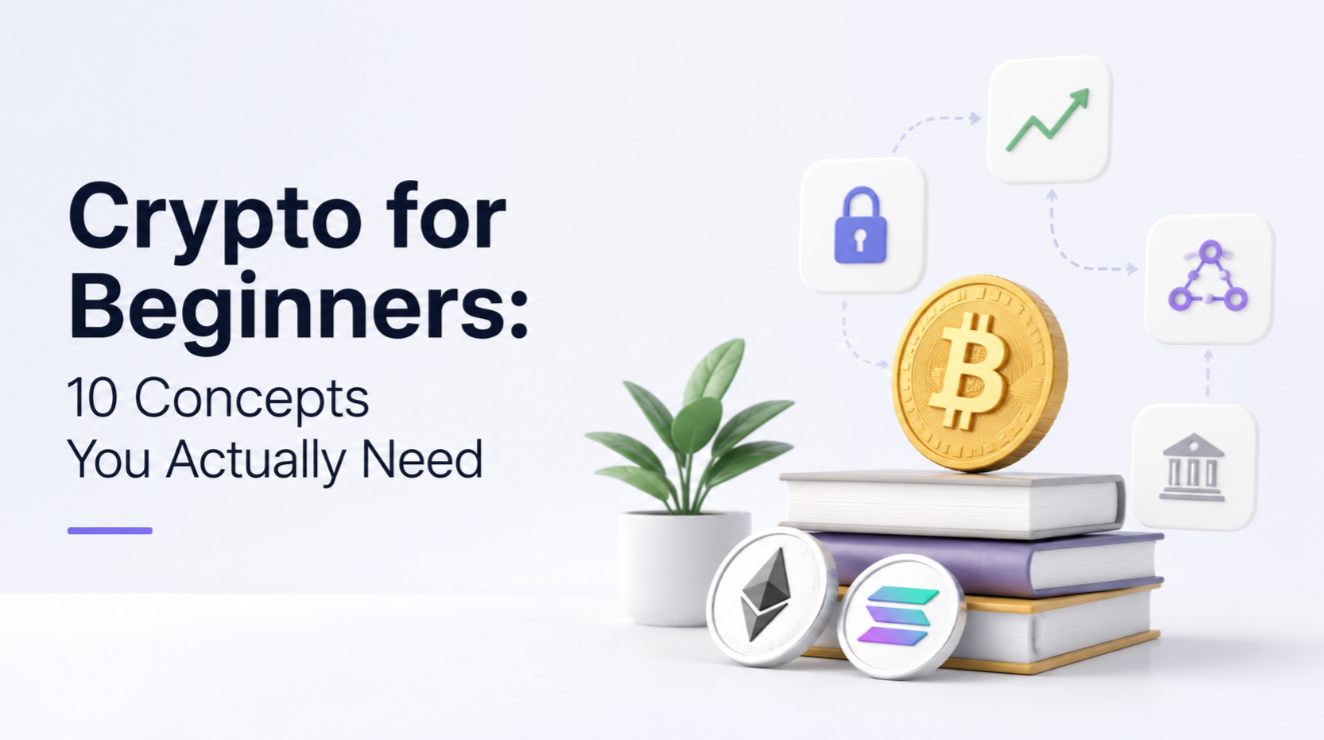
Crypto looks complicated because it borrows vocabulary from finance, computer science, and online culture at once. But underneath, ten ideas explain almost everything. Learn these and the rest of the field becomes navigable.
1. Blockchain
A blockchain is a database that everyone can read but no one can secretly edit. It is maintained by thousands of computers that all agree on the order of transactions. That shared ledger is what makes "trustless" money possible.
2. Wallets and private keys
You do not "have crypto in a wallet" the way you have cash. The wallet stores a private key that signs transactions on your behalf. Lose the key, lose access. This is why backups matter more than the wallet brand.
3. Gas fees
Every blockchain transaction has a cost paid in the chain's native token (ETH on Ethereum, SOL on Solana). Fees rise when the network is busy and fall when it is quiet. Layer 2 networks reduce them by orders of magnitude.
4. Layer 1 vs Layer 2
Layer 1 = base chains (Bitcoin, Ethereum, Solana). Layer 2 = networks built on top to scale them (Arbitrum, Base, Optimism, zkSync). L2s settle to their L1 but offer fees of cents instead of dollars.
5. Tokens and coins
A coin is the native asset of its chain (BTC, ETH, SOL). A token is built on top of a chain using a standard like ERC-20 (USDC, UNI, AAVE). Mechanically, they behave similarly; legally and economically, they often do not.
6. DeFi
Decentralized finance replicates banking — lending, trading, derivatives — using smart contracts instead of intermediaries. Aave, Uniswap, and Maker are the cornerstone protocols. Anyone with a wallet can use them, but smart contract risk replaces counterparty risk.
7. Stablecoins
Tokens pegged to fiat currencies, used as the dollar layer of crypto. USDC and USDT account for the overwhelming majority of stablecoin trading volume.
8. CEX vs DEX
Centralized exchanges (Binance, Coinbase) hold your funds and match orders internally. Decentralized exchanges (Uniswap, Jupiter) let you trade directly from your wallet. CEX wins on liquidity and fiat ramps; DEX wins on custody and access.
9. NFTs
Non-fungible tokens represent unique assets — art, gaming items, identity credentials, real estate titles. The speculation bubble burst in 2022, but utility-driven NFT usage continues quietly.
10. Governance and tokenomics
Many tokens grant voting rights over a protocol or DAO. Tokenomics — supply, emissions, vesting — often matter more for an investment's outcome than the technology itself.
Once these click, branch out: read our stablecoin guide, our wallet setup walkthrough, or jump straight into how to read a crypto chart.