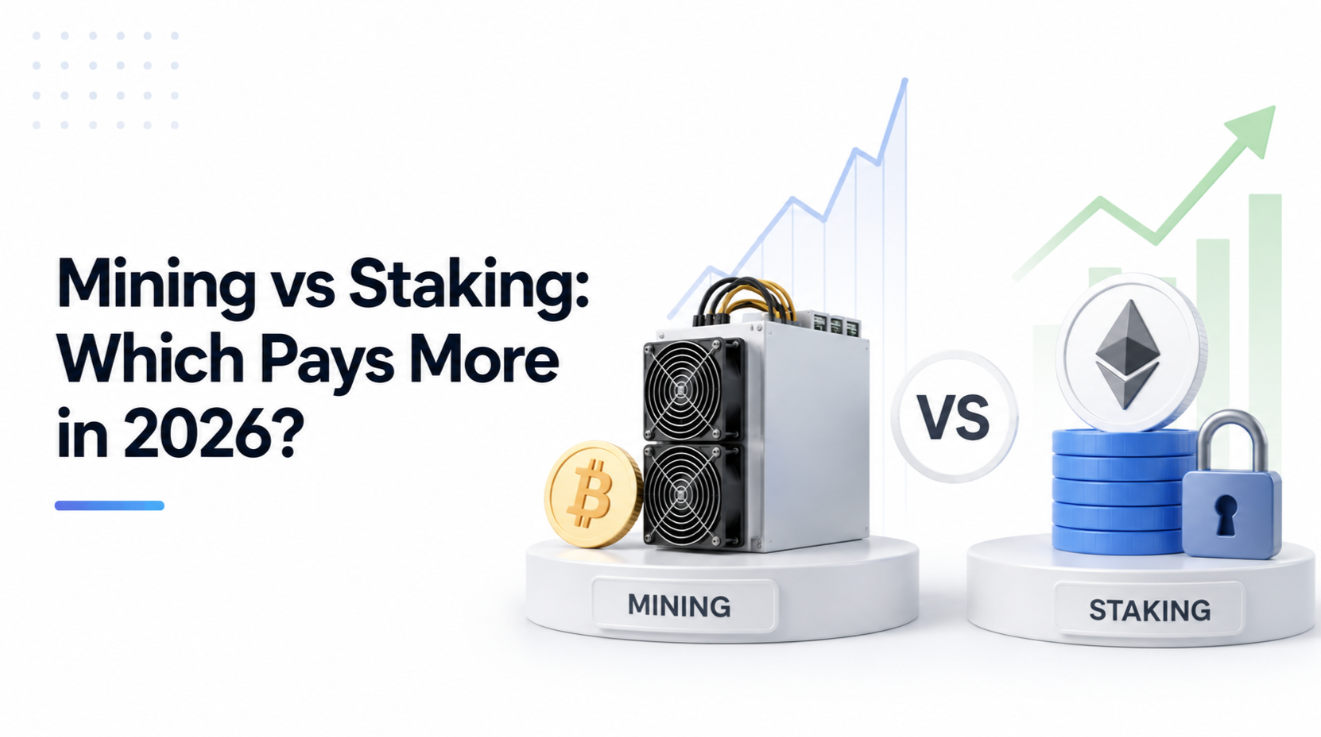
Bitcoin mining and Ethereum staking both let you earn passive income from securing a network. They look superficially similar; in practice, they are very different businesses. Here is the honest 2026 comparison.
Capital requirements
- Bitcoin mining — $3,000–6,000 per ASIC; meaningful business starts at $20k+ in hardware.
- Ethereum staking — Solo: 32 ETH (~$110k at $3,500). Liquid staking: any amount, even $20.
Yield in 2026
- Mining — Highly variable. At $0.05/kWh and current hashprice, ~15–25% annualised on hardware cost, before depreciation.
- ETH staking (solo) — 3.0–4.0% in ETH + ~0.5% MEV.
- ETH staking (liquid) — 2.8–3.4% in ETH after protocol fees.
- Restaking — Add 0.5–2% in AVS rewards on top of base staking.
Operational burden
Mining requires ongoing physical operations: power, cooling, noise management, hardware failures, firmware updates. Expect 1–3 hours per machine per month. Staking is mostly hands-off — solo validators need a reliable internet connection and occasional updates; liquid staking is fully passive.
Risk profile
- Mining — Hardware obsolescence (ASICs become uncompetitive in 3–5 years), electricity price spikes, BTC price drawdowns.
- Staking — Slashing (solo), smart contract risk (LSTs), peg risk (LSTs during stress), ETH price drawdowns.
Tax treatment
Mining income is usually self-employment income (US: subject to SE tax in addition to ordinary income). Staking rewards are typically ordinary income at receipt + capital gains on disposal. Specific treatment varies by country and structure; consult a CPA before serious operations.
Which suits which kind of holder
- Want maximum yield, willing to operate hardware — Mining, in cheap-power locations.
- Want simple, passive yield — Liquid staking ETH.
- Want some yield while keeping BTC exposure — Hold BTC, do not mine; mining is a business, not an investment.
- Want diversified exposure — Liquid stake ETH and hold BTC in self-custody.
See our mining profitability deep-dive and the Ethereum staking guide.